
Ch 13: Newton's Theory of Gravity
Knight Calc - Physics for Scientists and Engineers 5th Edition
Knight Calc5th EditionPhysics for Scientists and EngineersISBN: 9780137344796Not the one you use?Change textbook
Chapter 13, Problem 18

A space station orbits the sun at the same distance as the earth but on the opposite side of the sun. A small probe is fired away from the station. What minimum speed does the probe need to escape the solar system?

Verified step by step guidance
1
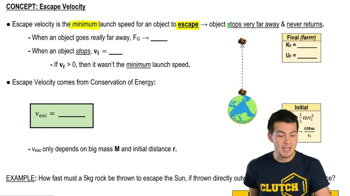
Step 1: Understand the concept of escape velocity. Escape velocity is the minimum speed required for an object to overcome the gravitational pull of a celestial body without further propulsion. In this case, the probe must escape the gravitational influence of the Sun.
Step 2: Write the formula for escape velocity. The escape velocity \( v_{esc} \) is given by \( v_{esc} = \sqrt{\frac{2GM}{r}} \), where \( G \) is the gravitational constant, \( M \) is the mass of the Sun, and \( r \) is the distance of the probe from the Sun.
Step 3: Determine the distance \( r \). Since the space station orbits the Sun at the same distance as Earth, \( r \) is equal to the average distance from the Earth to the Sun, which is approximately \( 1.496 \times 10^{11} \, \text{m} \).
Step 4: Substitute the known values into the formula. Use \( G = 6.674 \times 10^{-11} \, \text{m}^3 \text{kg}^{-1} \text{s}^{-2} \) and \( M = 1.989 \times 10^{30} \, \text{kg} \) for the mass of the Sun. Plug these values into \( v_{esc} = \sqrt{\frac{2GM}{r}} \).
Step 5: Simplify the expression to find the escape velocity. Perform the algebraic operations to calculate \( v_{esc} \), ensuring all units are consistent. This will give the minimum speed the probe needs to escape the solar system.

Verified video answer for a similar problem:

This video solution was recommended by our tutors as helpful for the problem above.
Was this helpful?

Key Concepts

Here are the essential concepts you must grasp in order to answer the question correctly.

Escape Velocity

Escape velocity is the minimum speed an object must reach to break free from the gravitational influence of a celestial body without further propulsion. For an object to escape the solar system, it must achieve a speed that overcomes the gravitational pull of the Sun, which is determined by the mass of the Sun and the distance from it.
Recommended video:
Guided course
7:27
Escape Velocity

Gravitational Force

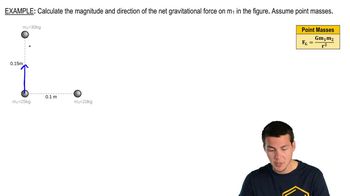
The gravitational force is the attractive force between two masses, described by Newton's law of universal gravitation. This force decreases with the square of the distance between the centers of the two masses, meaning that the farther an object is from the Sun, the weaker the gravitational pull it experiences, which is crucial for calculating escape velocity.
Recommended video:
Guided course
05:41
Gravitational Forces in 2D

Orbital Mechanics

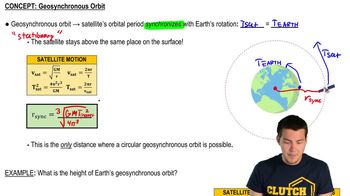
Orbital mechanics is the study of the motion of objects in space under the influence of gravitational forces. Understanding the principles of orbital mechanics is essential for determining how a probe can be launched from a space station to achieve the necessary trajectory and speed to escape the gravitational influence of the Sun and enter interstellar space.
Recommended video:
Guided course
04:45
Geosynchronous Orbits