
Ch 34: Ray Optics
Knight Calc - Physics for Scientists and Engineers 5th Edition
Knight Calc5th EditionPhysics for Scientists and EngineersISBN: 9780137344796Not the one you use?Change textbook
Chapter 34, Problem 6

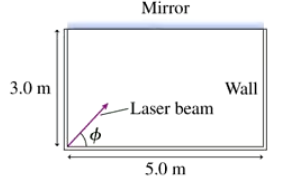
At what angle ϕ should the laser beam in FIGURE EX34.6 be aimed at the mirrored ceiling in order to hit the midpoint of the far wall?

Verified step by step guidance
1
Step 1: Analyze the geometry of the room. The room is rectangular with dimensions 3.0 m (height) and 5.0 m (width). The laser beam is aimed at the mirrored ceiling and must reflect to hit the midpoint of the far wall.
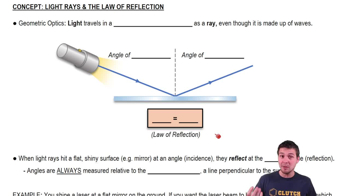
Step 2: Understand the reflection principle. The angle of incidence (ϕ) is equal to the angle of reflection. The laser beam will travel a path that forms a triangle with the mirrored ceiling and the far wall.
Step 3: Determine the coordinates of the midpoint of the far wall. Since the far wall is 5.0 m wide, the midpoint is located at 2.5 m horizontally from the left corner of the room.
Step 4: Use trigonometry to relate the angle ϕ to the dimensions of the room. The laser beam travels vertically 3.0 m to the mirrored ceiling and horizontally 2.5 m to the midpoint of the far wall. The tangent of the angle ϕ is given by: tan(ϕ)=2.53.0
Step 5: Solve for ϕ using the inverse tangent function. The angle ϕ can be calculated as: ϕ=tan(2.53.0). This gives the angle at which the laser beam should be aimed.

Verified video answer for a similar problem:

This video solution was recommended by our tutors as helpful for the problem above.
Was this helpful?

Key Concepts

Here are the essential concepts you must grasp in order to answer the question correctly.

Reflection of Light

Reflection of light occurs when a light ray bounces off a surface. The angle of incidence, which is the angle between the incoming ray and the normal (a line perpendicular to the surface), is equal to the angle of reflection. This principle is crucial for determining how the laser beam will interact with the mirrored ceiling to reach the midpoint of the wall.
Recommended video:
Guided course
06:25
Law of Reflection

Geometry of Angles

Understanding the geometry of angles is essential for solving this problem. The angle at which the laser beam is aimed (ϕ) and the angles formed by the reflection must be analyzed using geometric relationships. This includes recognizing that the total angle formed by the laser beam and the wall must be considered to find the correct aiming angle.
Recommended video:
Guided course
02:01
Flux Through Angled Surface

Trigonometric Functions

Trigonometric functions, such as sine, cosine, and tangent, are vital for calculating angles and distances in this scenario. By applying these functions, one can relate the angles of incidence and reflection to the dimensions of the room, allowing for the precise determination of the angle ϕ needed for the laser beam to hit the midpoint of the wall.
Recommended video:
Guided course
08:30
Intro to Wave Functions