Ch 26: Potential and Field
Knight Calc - Physics for Scientists and Engineers 5th Edition
Knight Calc5th EditionPhysics for Scientists and EngineersISBN: 9780137344796Not the one you use?Change textbook
Chapter 26, Problem 55a

Two 2.0 cm×2.0 cm metal electrodes are spaced 1.0 mm apart and connected by wires to the terminals of a 9.0 V battery. What are the charge on each electrode and the potential difference between them?

Verified step by step guidance
1
Step 1: Calculate the area of each electrode. The electrodes are square-shaped with sides of 2.0 cm. Convert the dimensions to meters (since SI units are required) and compute the area using the formula \( A = \text{side}^2 \).
Step 2: Determine the capacitance of the parallel plate capacitor formed by the electrodes. Use the formula \( C = \frac{\varepsilon_0 A}{d} \), where \( \varepsilon_0 \) is the permittivity of free space (\( 8.85 \times 10^{-12} \, \text{F/m} \)), \( A \) is the area of the plates, and \( d \) is the separation between the plates (1.0 mm, converted to meters).
Step 3: Use the relationship between charge, capacitance, and voltage to find the charge on each electrode. The formula is \( Q = CV \), where \( Q \) is the charge, \( C \) is the capacitance, and \( V \) is the potential difference (9.0 V).
Step 4: Confirm that the potential difference between the electrodes is equal to the voltage of the battery, which is given as 9.0 V. This is because the battery maintains a constant potential difference across the electrodes.
Step 5: Summarize the results: The charge on each electrode can be calculated using the formula \( Q = CV \), and the potential difference is directly provided as 9.0 V. Ensure all units are consistent throughout the calculations.

Verified video answer for a similar problem:

This video solution was recommended by our tutors as helpful for the problem above.
Video duration:
5m
Was this helpful?

Key Concepts

Here are the essential concepts you must grasp in order to answer the question correctly.

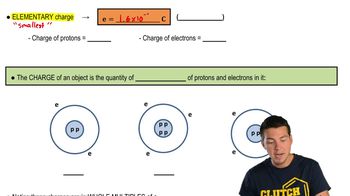
Electric Charge

Electric charge is a fundamental property of matter that causes it to experience a force when placed in an electromagnetic field. Charges can be positive or negative, and like charges repel while opposite charges attract. In the context of electrodes, the charge on each electrode is determined by the amount of current flowing through the circuit and the time for which it flows.
Recommended video:
Guided course
05:37
Electric Charge

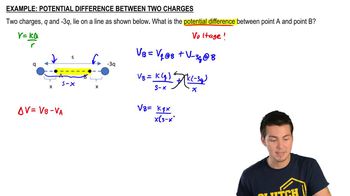
Potential Difference (Voltage)

Potential difference, or voltage, is the work done per unit charge to move a charge between two points in an electric field. It is measured in volts (V) and indicates how much energy is available to move charges through a circuit. In this scenario, the 9.0 V battery creates a potential difference between the two electrodes, which influences the charge distribution on them.
Recommended video:
Guided course
07:04
Potential Difference Between Two Charges

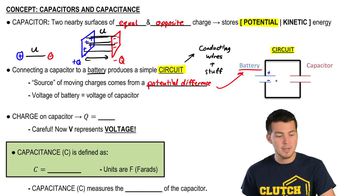
Capacitance

Capacitance is the ability of a system to store electric charge per unit voltage and is defined as the ratio of the charge (Q) on each electrode to the potential difference (V) between them. It is measured in farads (F). The capacitance of the electrodes can be calculated using their dimensions and the distance between them, which helps determine how much charge each electrode can hold when connected to the battery.
Recommended video:
Guided course
08:02
Capacitors & Capacitance (Intro)