Ch 13: Newton's Theory of Gravity
Knight Calc - Physics for Scientists and Engineers 5th Edition
Knight Calc5th EditionPhysics for Scientists and EngineersISBN: 9780137344796Not the one you use?Change textbook
Chapter 13, Problem 28

A new planet is discovered orbiting the star Vega in a circular orbit. The planet takes 55 earth years to complete one orbit around the star. Vega's mass is 2.1 times the sun's mass. What is the radius of the planet's orbit? Give your answer as a multiple of the radius of the earth's orbit.

Verified step by step guidance
1
Start by identifying the relevant formula for orbital motion. Use Kepler's Third Law, which relates the orbital period (T) and the radius of the orbit (r) for a planet orbiting a star: T2r31 = GM, where G is the gravitational constant and M is the mass of the star.
Simplify Kepler's Third Law for comparison with Earth's orbit. Since the problem asks for the radius as a multiple of Earth's orbital radius, express the ratio of the new planet's orbital radius (r) to Earth's orbital radius (rₑ): T2r3 = Tₑ2rₑ3, where Tₑ is Earth's orbital period (1 year) and rₑ is Earth's orbital radius.
Substitute the given values into the ratio. The orbital period of the new planet is T = 55 years, and Vega's mass is 2.1 times the Sun's mass. The ratio becomes: 552r3 = 12rₑ3 * 12.1.
Rearrange the equation to solve for the ratio of the orbital radii. Isolate rrₑ by taking the cube root of both sides: rrₑ = 5522.1.
Simplify the expression to find the ratio of the orbital radius of the new planet to Earth's orbital radius. This will give the radius of the planet's orbit as a multiple of Earth's orbital radius.

Verified video answer for a similar problem:

This video solution was recommended by our tutors as helpful for the problem above.
Video duration:
5m
Was this helpful?

Key Concepts

Here are the essential concepts you must grasp in order to answer the question correctly.

Kepler's Third Law of Planetary Motion

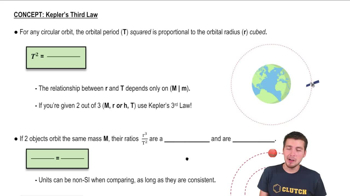
Kepler's Third Law states that the square of the orbital period of a planet is directly proportional to the cube of the semi-major axis of its orbit. This law can be expressed mathematically as T² ∝ r³, where T is the orbital period and r is the radius of the orbit. This relationship allows us to compare the orbits of different planets and is essential for determining the radius of the new planet's orbit around Vega.
Recommended video:
Guided course
08:32
Kepler's Third Law

Gravitational Force and Mass

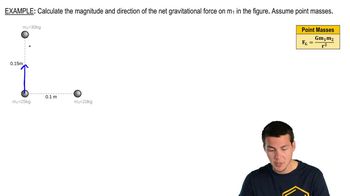
The gravitational force between two objects is determined by their masses and the distance between them, as described by Newton's law of universal gravitation. The formula F = G(m1*m2)/r² illustrates this relationship, where G is the gravitational constant. Understanding the mass of Vega, which is 2.1 times that of the Sun, is crucial for calculating the gravitational influence it has on the orbiting planet.
Recommended video:
Guided course
05:41
Gravitational Forces in 2D

Units of Measurement in Astronomy

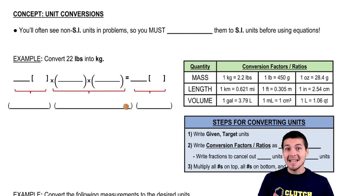
In astronomy, distances are often measured in astronomical units (AU), where 1 AU is the average distance from the Earth to the Sun, approximately 149.6 million kilometers. When calculating the radius of the new planet's orbit, it is important to express the result in terms of AU to provide a clear and standardized understanding of the distance relative to Earth's orbit.
Recommended video:
Guided course
07:46
Unit Conversions