Ch 13: Newton's Theory of Gravity
Knight Calc - Physics for Scientists and Engineers 5th Edition
Knight Calc5th EditionPhysics for Scientists and EngineersISBN: 9780137344796Not the one you use?Change textbook
Chapter 13, Problem 26

The asteroid belt circles the sun between the orbits of Mars and Jupiter. One asteroid has a period of 5.0 earth years. What are the asteroid's orbital radius and speed?

Verified step by step guidance
1
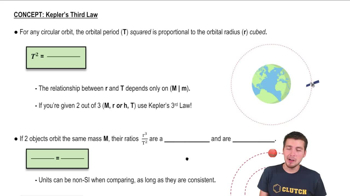
Use Kepler's Third Law, which states that the square of the orbital period (T) of a planet is proportional to the cube of the semi-major axis (r) of its orbit: T2 = r3K, where K is a constant for objects orbiting the Sun. For simplicity, in astronomical units (AU) and Earth years, K = 1.
Rearrange Kepler's Third Law to solve for the orbital radius (r): r = T23. Substitute T = 5.0 years into the equation.
Convert the orbital radius from astronomical units (AU) to meters if needed, using the conversion factor: 1 AU = 1.496×10¹¹ meters.
To find the orbital speed (v), use the formula for circular orbital motion: v = 2πrT. Ensure that the orbital radius (r) is in meters and the period (T) is in seconds (convert years to seconds using 1 year = 3.156×10⁷ seconds).
Substitute the values of r and T into the orbital speed formula to calculate the asteroid's speed. Ensure all units are consistent (meters for r and seconds for T).

Verified video answer for a similar problem:

This video solution was recommended by our tutors as helpful for the problem above.
Video duration:
5m
Was this helpful?

Key Concepts

Here are the essential concepts you must grasp in order to answer the question correctly.

Kepler's Third Law

Kepler's Third Law states that the square of the orbital period of a planet is directly proportional to the cube of the semi-major axis of its orbit. This law can be expressed mathematically as T² ∝ r³, where T is the orbital period and r is the average distance from the sun. This relationship allows us to determine the orbital radius of the asteroid based on its period.
Recommended video:
Guided course
08:32
Kepler's Third Law

Gravitational Force

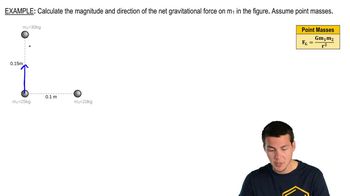
The gravitational force is the attractive force between two masses, described by Newton's law of universal gravitation. It states that the force is proportional to the product of the two masses and inversely proportional to the square of the distance between their centers. This force is crucial for understanding how celestial bodies, like asteroids, maintain their orbits around the sun.
Recommended video:
Guided course
05:41
Gravitational Forces in 2D

Orbital Speed

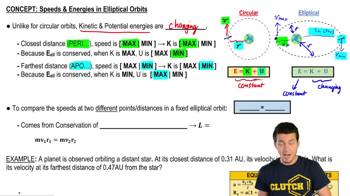
Orbital speed refers to the velocity at which an object travels along its orbit. It can be calculated using the formula v = 2πr/T, where v is the orbital speed, r is the orbital radius, and T is the orbital period. Understanding this concept is essential for determining how fast the asteroid moves in its orbit around the sun.
Recommended video:
Guided course
6:03
Speed and Energy of Elliptical Orbits
Related Practice
Textbook Question

A satellite orbits the sun with a period of 1.0 day. What is the radius of its orbit?

1
views

Textbook Question

A new planet is discovered orbiting the star Vega in a circular orbit. The planet takes 55 earth years to complete one orbit around the star. Vega's mass is 2.1 times the sun's mass. What is the radius of the planet's orbit? Give your answer as a multiple of the radius of the earth's orbit.

2
views
Textbook Question

Three satellites orbit a planet of radius R, as shown in FIGURE EX13.24. Satellites S1 and S3 have mass m. Satellite S2 has mass 2m. Satellite S1 orbits in 250 minutes and the force on S1 is 10,000 N. What is the kinetic-energy ratio for K1 / K3 for S1 and S3?

1
views
Textbook Question

Nothing can escape the event horizon of a black hole, not even light. You can think of the event horizon as being the distance from a black hole at which the escape speed is the speed of light, 3.00 ✕ 10⁸ m/s, making all escape impossible. What is the radius of the event horizon for a black hole with a mass 5.0 times the mass of the sun? This distance is called the Schwarzschild radius.

3
views
Textbook Question

A binary star system has two stars, each with the same mass as our sun, separated by 1.0 ✕ 1012 m. A comet is very far away and essentially at rest. Slowly but surely, gravity pulls the comet toward the stars. Suppose the comet travels along a trajectory that passes through the midpoint between the two stars. What is the comet's speed at the midpoint?

1
views
Textbook Question

A small moon orbits its planet in a circular orbit at a speed of 7.5 km/s. It takes 28 hours to complete one full orbit. What is the mass of the planet?

2
views