Ch. 19 - Heat and the First Law of Thermodynamics
Giancoli Douglas - Physics for Scientists and Engineers 5th edition
Giancoli Douglas5th editionPhysics for Scientists and EngineersISBN: 9780137488179Not the one you use?Change textbook
Chapter 19, Problem 26b

An iron boiler of mass 180 kg contains 710 kg of water at 18°C. A heater supplies energy at the rate of 58,000 kJ/h. How long does it take for the water to all have changed to steam?

Verified step by step guidance
1
Determine the energy required to heat the water from its initial temperature (18°C) to its boiling point (100°C). Use the formula: Q=mcT, where m is the mass of the water, c is the specific heat capacity of water (4.186 kJ/kg·°C), and T is the temperature change.
Calculate the energy required to convert the water at 100°C to steam. Use the formula: Q=mL, where m is the mass of the water and L is the latent heat of vaporization for water (2260 kJ/kg).
Add the energy required to heat the water to its boiling point and the energy required to convert it to steam. This gives the total energy required.
Determine the energy supplied per second by the heater. Convert the heater's power from kJ/h to kJ/s by dividing by 3600 (since there are 3600 seconds in an hour).
Divide the total energy required by the energy supplied per second to find the total time required. Use the formula: t=QP, where Q is the total energy and P is the power of the heater.

Verified video answer for a similar problem:

This video solution was recommended by our tutors as helpful for the problem above.
Video duration:
8m
Was this helpful?

Key Concepts

Here are the essential concepts you must grasp in order to answer the question correctly.

Specific Heat Capacity

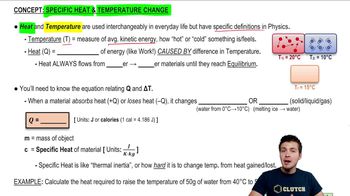
Specific heat capacity is the amount of heat required to raise the temperature of a unit mass of a substance by one degree Celsius. In this scenario, it is crucial to calculate how much energy is needed to heat the water from its initial temperature to its boiling point before it can change to steam.
Recommended video:
Guided course
06:50
Specific Heat & Temperature Changes

Latent Heat of Vaporization

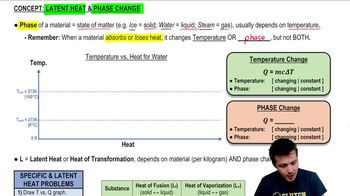
Latent heat of vaporization is the amount of energy required to convert a unit mass of a substance from liquid to gas at constant temperature. For water, this is significant because once the water reaches its boiling point, additional energy is needed to convert it into steam without changing its temperature.
Recommended video:
Guided course
10:40
Latent Heat & Phase Changes

Energy Transfer Rate

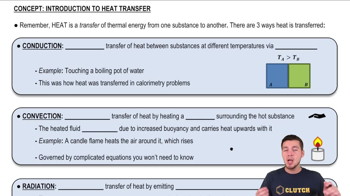
The energy transfer rate, in this case, is the power output of the heater, measured in kJ/h. Understanding this rate is essential to determine how long it will take to supply the necessary energy to both heat the water to boiling and then convert it to steam.
Recommended video:
Guided course
05:14
Overview of Heat Transfer