Textbook Question
For the vectors A and B in Fig. E1.24, use a scale drawing to find the magnitude and direction of the vector difference A − B.
7
views

 Young & Freedman Calc 14th EditionCh 01: Units, Physical Quantities & VectorsProblem 27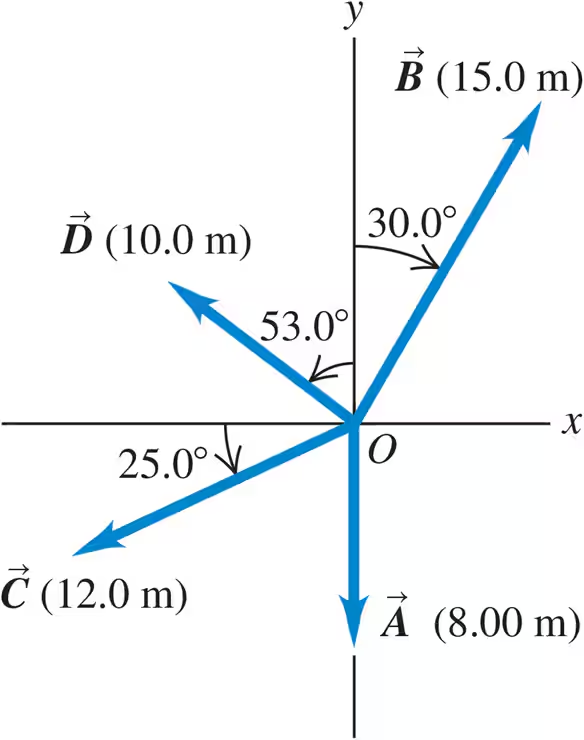
 Verified step by step guidance
 07:30
07:30
 08:30
08:30 14:10
14:10For the vectors A and B in Fig. E1.24, use a scale drawing to find the magnitude and direction of the vector difference A − B.
Vector A has y-component Ay = +9.60 m. A makes an angle of 32.0° counterclockwise from the +y-axis. (a) What is the x-component of A? (b) What is the magnitude of A?
Let θ be the angle that the vector A makes with the +x-axis, measured counterclockwise from that axis. Find angle θ for a vector that has these components: Ax = 2.00m, Ay = −1.00 m
A spelunker is surveying a cave. She follows a passage 180 m straight west, then 210 m in a direction 45° east of south, and then 280 m at 30° east of north. After a fourth displacement, she finds herself back where she started. Use a scale drawing to determine the magnitude and direction of the fourth displacement.
For the vectors A and B in Fig. E1.24, use a scale drawing to find the magnitude and direction of the vector sum A + B
For the vectors A and B in Fig. E1.24 use the method of components to find the magnitude and direction of the vector sum A + B