Ch 01: Units, Physical Quantities & Vectors
Young & Freedman Calc - University Physics 14th Edition
Young & Freedman Calc14th EditionUniversity PhysicsISBN: 9780321973610Not the one you use?Change textbook
Chapter 1, Problem 26

A spelunker is surveying a cave. She follows a passage 180 m straight west, then 210 m in a direction 45° east of south, and then 280 m at 30° east of north. After a fourth displacement, she finds herself back where she started. Use a scale drawing to determine the magnitude and direction of the fourth displacement.

Verified step by step guidance
1
Begin by understanding the problem: The spelunker makes three displacements and returns to her starting point after a fourth displacement. We need to find the magnitude and direction of this fourth displacement.
Break down each displacement into its vector components. For the first displacement, 180 m straight west, the vector is (-180, 0) in Cartesian coordinates, assuming east is positive x and north is positive y.
For the second displacement, 210 m at 45° east of south, calculate the components using trigonometry. The x-component is 210 * sin(45°) and the y-component is -210 * cos(45°), as it is southward.
For the third displacement, 280 m at 30° east of north, calculate the components similarly. The x-component is 280 * sin(30°) and the y-component is 280 * cos(30°), as it is northward.
Add the components of the three displacements to find the resultant vector. The fourth displacement will be the negative of this resultant vector, as it brings the spelunker back to the starting point. Calculate the magnitude and direction using the Pythagorean theorem and inverse tangent function.

Verified video answer for a similar problem:

This video solution was recommended by our tutors as helpful for the problem above.
Video duration:
20m
Was this helpful?

Key Concepts

Here are the essential concepts you must grasp in order to answer the question correctly.

Vector Addition

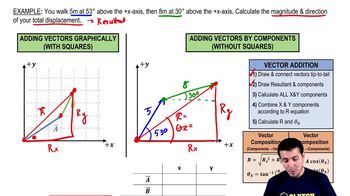
Vector addition is the process of combining vectors to determine a resultant vector. In this problem, the spelunker's movements can be represented as vectors, each with a magnitude and direction. By adding these vectors graphically or mathematically, we can find the resultant vector that returns her to the starting point.
Recommended video:
Guided course
07:30
Vector Addition By Components

Trigonometry in Physics

Trigonometry is essential for resolving vectors into their components, especially when dealing with angles. The spelunker's movements involve directions given in degrees, requiring the use of sine and cosine functions to break down each vector into horizontal and vertical components, facilitating accurate vector addition.
Recommended video:
Guided course
3:26
Trigonometry

Scale Drawing

A scale drawing is a graphical representation that maintains proportionality between the actual distances and the drawn distances. In this problem, a scale drawing helps visualize the spelunker's path and determine the magnitude and direction of the fourth displacement by accurately plotting each vector and measuring the resultant vector.
Recommended video:
Guided course
04:54
Introduction To Temperature Scales