
Ch 09: Rotation of Rigid Bodies
Young & Freedman Calc - University Physics 14th Edition
Young & Freedman Calc14th EditionUniversity PhysicsISBN: 9780321973610Not the one you use?Change textbook
Chapter 9, Problem 37

A uniform sphere with mass 28.028.0 kg and radius 0.3800.380 m is rotating at constant angular velocity about a stationary axis that lies along a diameter of the sphere. If the kinetic energy of the sphere is 236236 J, what is the tangential velocity of a point on the rim of the sphere?

Verified step by step guidance
1
Step 1: Recall the formula for rotational kinetic energy, which is given by \( KE = \frac{1}{2} I \omega^2 \), where \( KE \) is the rotational kinetic energy, \( I \) is the moment of inertia, and \( \omega \) is the angular velocity.
Step 2: For a uniform sphere rotating about a diameter, the moment of inertia \( I \) is \( \frac{2}{5} m r^2 \), where \( m \) is the mass of the sphere and \( r \) is its radius. Substitute the given values \( m = 28.0 \ \text{kg} \) and \( r = 0.380 \ \text{m} \) into this formula to calculate \( I \).
Step 3: Rearrange the rotational kinetic energy formula to solve for \( \omega \): \( \omega = \sqrt{\frac{2 KE}{I}} \). Substitute the given \( KE = 236 \ \text{J} \) and the calculated \( I \) from Step 2 into this equation to find \( \omega \).
Step 4: The tangential velocity \( v_t \) of a point on the rim of the sphere is related to the angular velocity \( \omega \) by the formula \( v_t = r \omega \). Use the radius \( r = 0.380 \ \text{m} \) and the calculated \( \omega \) from Step 3 to find \( v_t \).
Step 5: Combine all the results from the previous steps to express \( v_t \) in terms of the given quantities. This will give the tangential velocity of a point on the rim of the sphere.

Verified video answer for a similar problem:

This video solution was recommended by our tutors as helpful for the problem above.
Video duration:
3m
Was this helpful?

Key Concepts

Here are the essential concepts you must grasp in order to answer the question correctly.

Angular Velocity

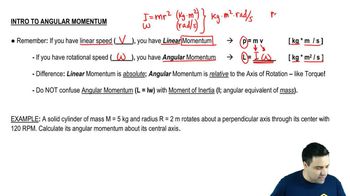
Angular velocity is a measure of how quickly an object rotates around an axis, expressed in radians per second. For a rotating object, it relates to the linear velocity of points on the object’s surface through the equation v = ωr, where v is the tangential velocity, ω is the angular velocity, and r is the radius. Understanding angular velocity is crucial for determining the motion of points on a rotating sphere.
Recommended video:
Guided course
06:18
Intro to Angular Momentum

Kinetic Energy of Rotation

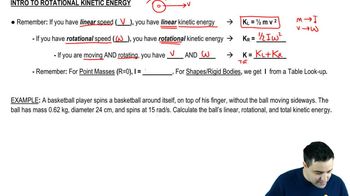
The kinetic energy of a rotating object is given by the formula KE = 0.5 I ω², where I is the moment of inertia and ω is the angular velocity. For a uniform sphere, the moment of inertia is I = (2/5)mr², where m is the mass and r is the radius. This concept is essential for relating the sphere's kinetic energy to its rotational motion and ultimately finding the tangential velocity.
Recommended video:
Guided course
06:07
Intro to Rotational Kinetic Energy

Tangential Velocity

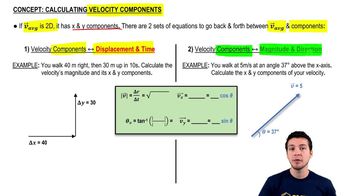
Tangential velocity is the linear speed of a point on the circumference of a rotating object, calculated as v = ωr. It represents how fast a point moves along its circular path and is directly proportional to both the angular velocity and the radius of the object. In this problem, finding the tangential velocity of a point on the rim of the sphere requires understanding its relationship with angular velocity and radius.
Recommended video:
Guided course
05:53
Calculating Velocity Components
Related Practice
Textbook Question

A compound disk of outside diameter 140.0 cm is made up of a uniform solid disk of radius 50.0 cm and area density 3.00 g/cm2 surrounded by a concentric ring of inner radius 50.0 cm, outer radius 70.0 cm, and area density 2.00 g/cm2. Find the moment of inertia of this object about an axis perpendicular to the plane of the object and passing through its center.

2
views
Textbook Question

If we multiply all the design dimensions of an object by a scaling factor f, its volume and mass will be multiplied by f3. By what factor will its moment of inertia be multiplied?

2
views
Textbook Question

A uniform 2.00-m ladder of mass 9.00 kg is leaning against a vertical wall while making an angle of 53.0° with the floor. A worker pushes the ladder up against the wall until it is vertical. What is the increase in the gravitational potential energy of the ladder?

2
views
Textbook Question

A wheel is turning about an axis through its center with constant angular acceleration. Starting from rest, at t = 0, the wheel turns through 8.20 revolutions in 12.0 s. At t = 12.0 s the kinetic energy of the wheel is 36.0 J. For an axis through its center, what is the moment of inertia of the wheel?

1
views
Textbook Question

An airplane propeller is 2.08 m in length (from tip to tip) with mass 117 kg and is rotating at 2400 rpm (rev/min) about an axis through its center. You can model the propeller as a slender rod.

(a) What is its rotational kinetic energy?

(b) Suppose that, due to weight constraints, you had to reduce the propeller's mass to 75.0% of its original mass, but you still needed to keep the same size and kinetic energy. What would its angular speed have to be, in rpm?

1
views
Textbook Question

The flywheel of a gasoline engine is required to give up 500 J of kinetic energy while its angular velocity decreases from 650 rev/min to 520 rev/min. What moment of inertia is required?

1
views