
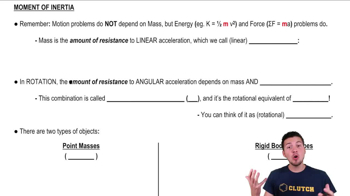
A compound disk of outside diameter 140.0 cm is made up of a uniform solid disk of radius 50.0 cm and area density 3.00 g/cm2 surrounded by a concentric ring of inner radius 50.0 cm, outer radius 70.0 cm, and area density 2.00 g/cm2. Find the moment of inertia of this object about an axis perpendicular to the plane of the object and passing through its center.
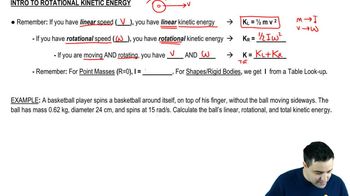
The flywheel of a gasoline engine is required to give up 500 J of kinetic energy while its angular velocity decreases from 650 rev/min to 520 rev/min. What moment of inertia is required?
Verified step by step guidance
Verified video answer for a similar problem:
Key Concepts
Kinetic Energy of Rotation
Moment of Inertia
Angular Velocity Conversion
If we multiply all the design dimensions of an object by a scaling factor f, its volume and mass will be multiplied by f3. By what factor will its moment of inertia be multiplied?
A uniform sphere with mass kg and radius m is rotating at constant angular velocity about a stationary axis that lies along a diameter of the sphere. If the kinetic energy of the sphere is J, what is the tangential velocity of a point on the rim of the sphere?
A uniform 2.00-m ladder of mass 9.00 kg is leaning against a vertical wall while making an angle of 53.0° with the floor. A worker pushes the ladder up against the wall until it is vertical. What is the increase in the gravitational potential energy of the ladder?
A wheel is turning about an axis through its center with constant angular acceleration. Starting from rest, at t = 0, the wheel turns through 8.20 revolutions in 12.0 s. At t = 12.0 s the kinetic energy of the wheel is 36.0 J. For an axis through its center, what is the moment of inertia of the wheel?
If we multiply all the design dimensions of an object by a scaling factor f, its volume and mass will be multiplied by f3. If a 1/48 scale model has a rotational kinetic energy of 2.5 J, what will be the kinetic energy for the full-scale object of the same material rotating at the same angular velocity?
