
In a nuclear physics experiment, a proton is fired toward a Z = 13 nucleus with the diameter and neutron energy levels shown in Figure 40.17. The nucleus, which was initially in its ground state, subsequently emits a gamma ray with wavelength 1.73×10⁻⁴ nm. What was the minimum initial speed of the proton? Hint: Don't neglect the proton-nucleus collision.
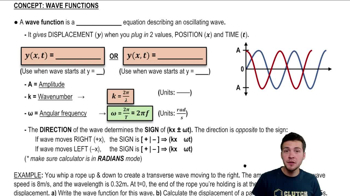
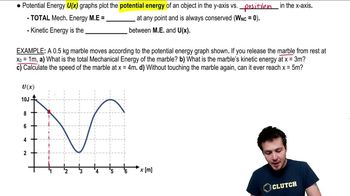
CALC A particle of mass m has the wave function ψ(x) = Ax exp (−x²/a²) when it is in an allowed energy level with E = 0. Find and graph the potential-energy function U(x).
Verified step by step guidance
Verified video answer for a similar problem:
Key Concepts
Wave Function
Potential Energy Function
Energy Levels in Quantum Mechanics
CALC A particle of mass m has the wave function ψ(x) = Ax exp (−x²/a²) when it is in an allowed energy level with E = 0. Draw a graph of ψ(x) versus x.
CALC A particle of mass m has the wave function ψ(x) = Ax exp (−x²/a²) when it is in an allowed energy level with E = 0. At what value or values of x is the particle most likely to be found?
Figure 40.17 showed that a typical nuclear radius is 4.0 fm. As you’ll learn in Chapter 42, a typical energy of a neutron bound inside the nuclear potential well is En = −20 MeV. To find out how “fuzzy” the edge of the nucleus is, what is the neutron’s penetration distance into the classically forbidden region as a fraction of the nuclear radius?
CALC Determine the normalization constant A1 for the n = 1 ground-state wave function of the quantum harmonic oscillator. Your answer will be in terms of b.
A proton’s energy is 1.0 MeV below the top of a 10-fm-wide energy barrier. What is the probability that the proton will tunnel through the barrier?
