
Ch 19: Work, Heat, and the First Law of Thermodynamics
Knight Calc - Physics for Scientists and Engineers 5th Edition
Knight Calc5th EditionPhysics for Scientists and EngineersISBN: 9780137344796Not the one you use?Change textbook
Chapter 19, Problem 16

What is the maximum mass of ethyl alcohol you could boil with 1000 J of heat, starting from 20°C?

Verified step by step guidance
1
Step 1: Identify the relevant physical properties of ethyl alcohol. You need its specific heat capacity (c), boiling point, and heat of vaporization (L). For ethyl alcohol, c ≈ 2.44 J/(g·°C), boiling point ≈ 78°C, and L ≈ 846 J/g.
Step 2: Calculate the heat required to raise the temperature of ethyl alcohol from 20°C to its boiling point (78°C). Use the formula: Q = m × c × ΔT, where Q is the heat, m is the mass, c is the specific heat capacity, and ΔT is the temperature change.
Step 3: Determine the heat required to vaporize the ethyl alcohol once it reaches its boiling point. Use the formula: Q = m × L, where Q is the heat, m is the mass, and L is the heat of vaporization.
Step 4: Combine the two heat calculations from Steps 2 and 3. The total heat provided (1000 J) must equal the sum of the heat required to raise the temperature and the heat required to vaporize the ethyl alcohol. Set up the equation: 1000 = m × c × ΔT + m × L.
Step 5: Solve for the mass (m) of ethyl alcohol. Rearrange the equation from Step 4 to isolate m, and substitute the known values for c, ΔT, and L. This will give you the maximum mass of ethyl alcohol that can be boiled with 1000 J of heat.

Verified video answer for a similar problem:

This video solution was recommended by our tutors as helpful for the problem above.
Video duration:
8m
Was this helpful?

Key Concepts

Here are the essential concepts you must grasp in order to answer the question correctly.

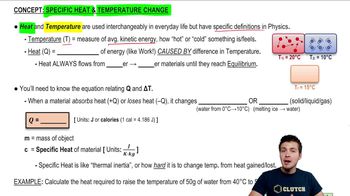
Specific Heat Capacity

Specific heat capacity is the amount of heat required to raise the temperature of a unit mass of a substance by one degree Celsius. For ethyl alcohol, this value is essential to determine how much energy is needed to increase its temperature from an initial state to its boiling point before phase change occurs.
Recommended video:
Guided course
06:50
Specific Heat & Temperature Changes

Latent Heat of Vaporization

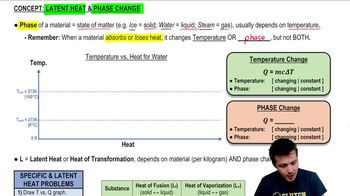
Latent heat of vaporization is the amount of heat required to convert a unit mass of a substance from liquid to gas at its boiling point without changing its temperature. This concept is crucial for calculating how much energy is needed to boil ethyl alcohol after it has reached its boiling point.
Recommended video:
Guided course
10:40
Latent Heat & Phase Changes

Energy Conservation

The principle of energy conservation states that energy cannot be created or destroyed, only transformed from one form to another. In this context, the total energy provided (1000 J) must be accounted for in both raising the temperature of ethyl alcohol and converting it to vapor, guiding the calculations for maximum mass that can be boiled.
Recommended video:
Guided course
06:24
Conservation Of Mechanical Energy
Related Practice
Textbook Question

500 J of heat energy are transferred to a gas during a process in which the gas expands at constant pressure from 400 cm3 to 800 cm3. The gas's thermal energy increases by 300 J during this process. What is the gas pressure?

1
views
Textbook Question

Two cars collide head-on while each is traveling at 80 km/h. Suppose all their kinetic energy is transformed into the thermal energy of the wrecks. What is the temperature increase of each car? You can assume that each car's specific heat is that of iron.

2
views
Textbook Question

How much heat energy must be added to a 6.0-cm-diameter copper sphere to raise its temperature from −50°C to 150°C?

Textbook Question

A rapidly spinning paddle wheel raises the temperature of 200 mL of water from 21°C to 25°C. How much heat is transferred?

1
views
Textbook Question

One way you keep from overheating is by perspiring. Evaporation—a phase change—requires heat, and the heat energy is removed from your body. Evaporation is much like boiling, only water's heat of vaporization at 35°C is a somewhat larger 24×105 J/kg because at lower temperatures more energy is required to break the molecular bonds. Very strenuous activity can cause an adult human to produce 30 g of perspiration per minute. If all the perspiration evaporates, rather than dripping off, at what rate (in J/s) is it possible to exhaust heat by perspiring?

1
views
Textbook Question

An experiment measures the temperature of a 500 g substance while steadily supplying heat to it. FIGURE EX19.20 shows the results of the experiment. What are the heats of fusion and vaporization?

1
views