
Textbook Question
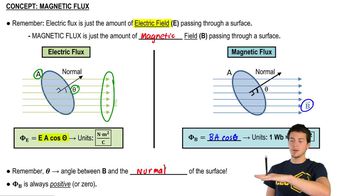
A flat, square surface with side length is in the xy-plane at . Calculate the magnitude of the flux through this surface produced by a magnetic field .
1
views

 Verified step by step guidance
 04:52
04:52
 01:04
01:04 04:05
04:05A flat, square surface with side length is in the xy-plane at . Calculate the magnitude of the flux through this surface produced by a magnetic field .
Cyclotrons are widely used in nuclear medicine for producing short-lived radioactive isotopes. These cyclotrons typically accelerate H- (the hydride ion, which has one proton and two electrons) to an energy of 5 MeV to 20 MeV. This ion has a mass very close to that of a proton because the electron mass is negligible — about 1/2000 of the proton's mass. A typical magnetic field in such cyclotrons is 1.9 T. (a) What is the speed of a 5.0 MeV H-? (b) If the H- has energy 5.0 MeV and B = 1.9 T, what is the radius of this ion's circular orbit?
A 150 g ball containing 4.00 x 10⁸ excess electrons is dropped into a 125 m vertical shaft. At the bottom of the shaft, the ball suddenly enters a uniform horizontal magnetic field that has magnitude 0.250 T and direction from east to west. If air resistance is negligibly small, find the magnitude and direction of the force that this magnetic field exerts on the ball just as it enters the field.
A horizontal rectangular surface has dimensions 2.80 cm by 3.20 cm and is in a uniform magnetic field that is directed at an angle of 30.0° above the horizontal. What must the magnitude of the magnetic field be to produce a flux of 3.10 x 10⁻⁴ Wb through the surface?
A deuteron (the nucleus of an isotope of hydrogen) has a mass of 3.34 x 10⁻²⁷ kg and a charge of +e. The deuteron travels in a circular path with a radius of 6.96 mm in a magnetic field with magnitude 2.50 T. (a) Find the speed of the deuteron. (b) Find the time required for it to make half a revolution. (c) Through what potential difference would the deuteron have to be accelerated to acquire this speed?
A circular area with a radius of 6.50 cm lies in the xy-plane. What is the magnitude of the magnetic flux through this circle due to a uniform magnetic field B = 0.230 T at an angle of 53.1° from the +z-direction?