
Ch. 03 - Kinematics in Two or Three Dimensions; Vectors
Giancoli Douglas - Physics for Scientists and Engineers 5th edition
Giancoli Douglas5th editionPhysics for Scientists and EngineersISBN: 9780137488179Not the one you use?Change textbook
Chapter 3, Problem 92b

A person in the passenger basket of a hot-air balloon throws a ball horizontally outward from the basket with speed 12.0 m/s (Fig. 3–64). What initial velocity (magnitude and direction) does the ball have relative to a person standing on the ground if the hot-air balloon is descending at 3.0 m/s relative to the ground?
<IMAGE>

Verified step by step guidance
1
Identify the reference frames: The problem involves two reference frames - the hot-air balloon (from which the ball is thrown) and the ground (relative to which the velocity is to be determined). The velocity of the ball relative to the ground is the vector sum of the velocity of the ball relative to the balloon and the velocity of the balloon relative to the ground.
Express the given velocities: The velocity of the ball relative to the balloon is horizontal and has a magnitude of 12.0 m/s. The velocity of the balloon relative to the ground is vertical and has a magnitude of 3.0 m/s downward. Represent these velocities as vectors: \( \vec{v}_{\text{ball/balloon}} = 12.0 \ \text{m/s} \ \hat{i} \) and \( \vec{v}_{\text{balloon/ground}} = -3.0 \ \text{m/s} \ \hat{j} \).
Determine the velocity of the ball relative to the ground: Use vector addition to find \( \vec{v}_{\text{ball/ground}} \), which is the sum of \( \vec{v}_{\text{ball/balloon}} \) and \( \vec{v}_{\text{balloon/ground}} \). Mathematically, \( \vec{v}_{\text{ball/ground}} = \vec{v}_{\text{ball/balloon}} + \vec{v}_{\text{balloon/ground}} \). Substituting the vectors, \( \vec{v}_{\text{ball/ground}} = 12.0 \ \hat{i} - 3.0 \ \hat{j} \).
Calculate the magnitude of the velocity: The magnitude of the velocity vector is given by \( |\vec{v}_{\text{ball/ground}}| = \sqrt{(v_x)^2 + (v_y)^2} \), where \( v_x = 12.0 \ \text{m/s} \) and \( v_y = -3.0 \ \text{m/s} \). Substitute these values into the formula to compute the magnitude.
Determine the direction of the velocity: The direction of the velocity is given by the angle \( \theta \) relative to the horizontal, where \( \tan \theta = \frac{v_y}{v_x} \). Use \( v_x = 12.0 \ \text{m/s} \) and \( v_y = -3.0 \ \text{m/s} \) to calculate \( \theta \). Note that the negative \( v_y \) indicates the angle is below the horizontal.

Verified video answer for a similar problem:

This video solution was recommended by our tutors as helpful for the problem above.
Was this helpful?

Key Concepts

Here are the essential concepts you must grasp in order to answer the question correctly.

Relative Velocity

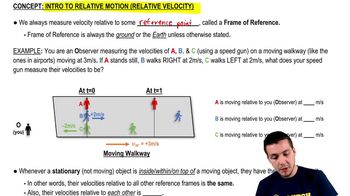
Relative velocity is the velocity of an object as observed from a particular reference frame. In this scenario, the ball's velocity must be analyzed from both the balloon's frame and the ground's frame. The relative velocity of the ball to the ground is the vector sum of its velocity relative to the balloon and the balloon's velocity relative to the ground.
Recommended video:
Guided course
04:27
Intro to Relative Motion (Relative Velocity)

Vector Addition

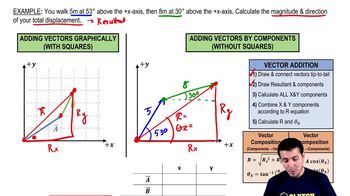
Vector addition is the process of combining two or more vectors to determine a resultant vector. In this case, the horizontal velocity of the ball (12.0 m/s) and the vertical velocity of the descending balloon (3.0 m/s downward) must be added as vectors. This involves considering both the magnitude and direction of each vector to find the overall velocity of the ball relative to the ground.
Recommended video:
Guided course
07:30
Vector Addition By Components

Projectile Motion

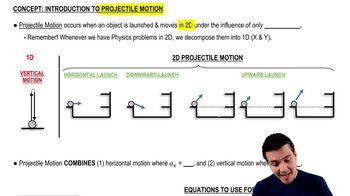
Projectile motion refers to the motion of an object that is launched into the air and is subject to gravitational acceleration. The ball thrown from the balloon follows a parabolic trajectory, influenced by its initial horizontal velocity and the downward acceleration due to gravity. Understanding projectile motion helps in predicting the ball's path and final velocity relative to the ground.
Recommended video:
Guided course
04:44
Introduction to Projectile Motion