Ch 04: Kinematics in Two Dimensions
Knight Calc - Physics for Scientists and Engineers 5th Edition
Knight Calc5th EditionPhysics for Scientists and EngineersISBN: 9780137344796Not the one you use?Change textbook
Chapter 4, Problem 4a

At this instant, the particle is speeding up and curving upward. What is the direction of its acceleration?

Verified step by step guidance
1
Analyze the motion of the particle: The particle is curving upward, which indicates that it is undergoing circular motion or a curved trajectory. The velocity vector is tangent to the curve at any given point.
Understand the components of acceleration: Acceleration can have two components in this scenario: (1) a tangential component that changes the magnitude of the velocity (speeding up or slowing down), and (2) a centripetal component that changes the direction of the velocity (curving motion).
Determine the tangential acceleration: Since the particle is speeding up, the tangential acceleration is in the same direction as the velocity vector, which is along the tangent to the curve.
Determine the centripetal acceleration: The centripetal acceleration always points toward the center of the curvature of the path. In this case, it points upward and slightly to the left, perpendicular to the velocity vector.
Combine the components: The net acceleration is the vector sum of the tangential and centripetal accelerations. It will point in a direction that is slightly upward and to the left, combining the effects of speeding up and curving upward.

Verified video answer for a similar problem:

This video solution was recommended by our tutors as helpful for the problem above.
Video duration:
2m
Was this helpful?

Key Concepts

Here are the essential concepts you must grasp in order to answer the question correctly.

Acceleration

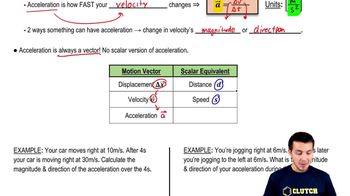
Acceleration is the rate of change of velocity of an object. It is a vector quantity, meaning it has both magnitude and direction. When a particle is speeding up, its acceleration is in the same direction as its velocity. In the context of circular or curved motion, acceleration can also change direction even if the speed remains constant.
Recommended video:
Guided course
05:47
Intro to Acceleration

Centripetal Acceleration

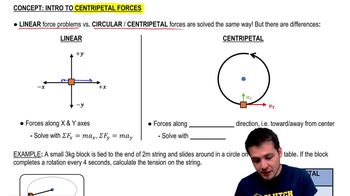
Centripetal acceleration occurs when an object moves along a curved path, directed towards the center of the curvature. This type of acceleration is essential for maintaining circular motion and is always perpendicular to the object's velocity vector. In the case of a particle curving upward, the centripetal acceleration points inward toward the center of the curve.
Recommended video:
Guided course
06:48
Intro to Centripetal Forces

Net Force and Direction of Acceleration

According to Newton's second law, the net force acting on an object determines its acceleration. The direction of the net force is the same as the direction of the acceleration. In the scenario described, if the particle is curving upward and speeding up, the net force must have a component acting in the upward direction, indicating that the acceleration is also directed upward.
Recommended video:
Guided course
07:32
Weight Force & Gravitational Acceleration