Ch 04: Kinematics in Two Dimensions
Knight Calc - Physics for Scientists and Engineers 5th Edition
Knight Calc5th EditionPhysics for Scientists and EngineersISBN: 9780137344796Not the one you use?Change textbook
Chapter 4, Problem 6a

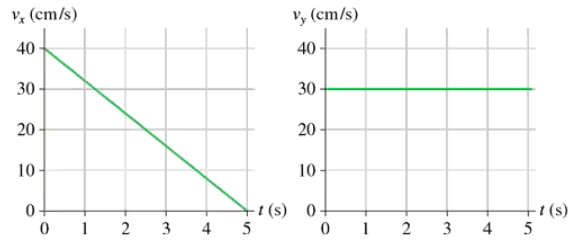
A rocket-powered hockey puck moves on a horizontal frictionless table. FIGURE EX4.6 shows graphs of vx and vy, the x- and y-components of the puck's velocity. The puck starts at the origin. In which direction is the puck moving at t = 2s? Give your answer as an angle from the x-axis.

Verified step by step guidance
1
Step 1: Analyze the graph for the x-component of velocity (v_x). From the graph, we observe that v_x is constant at -3 m/s for all times, including t = 2s. This indicates that the puck is moving in the negative x-direction with a constant velocity.
Step 2: Analyze the graph for the y-component of velocity (v_y). At t = 2s, the graph shows that v_y is decreasing linearly. By reading the graph, we find that v_y at t = 2s is approximately 3 m/s. This indicates that the puck is moving in the positive y-direction at this instant.
Step 3: Combine the x- and y-components of velocity to determine the direction of motion. The puck's velocity vector at t = 2s can be represented as v = (-3 m/s) î + (3 m/s) ĵ, where î and ĵ are unit vectors in the x- and y-directions, respectively.
Step 4: Calculate the angle of the velocity vector relative to the x-axis. The angle θ can be found using the formula tan(θ) = v_y / v_x. Substituting the values, tan(θ) = 3 / -3.
Step 5: Solve for θ using the inverse tangent function. Since v_x is negative and v_y is positive, the angle will be in the second quadrant. Use θ = arctan(v_y / v_x) and adjust for the quadrant to find the direction of motion relative to the x-axis.

Verified video answer for a similar problem:

This video solution was recommended by our tutors as helpful for the problem above.
Video duration:
5m
Was this helpful?

Key Concepts

Here are the essential concepts you must grasp in order to answer the question correctly.

Velocity Components

Velocity can be broken down into its components along the x and y axes. The x-component (vx) indicates motion in the horizontal direction, while the y-component (vy) indicates motion in the vertical direction. Understanding these components is crucial for determining the overall direction of an object's motion, especially when analyzing two-dimensional motion.
Recommended video:
Guided course
05:53
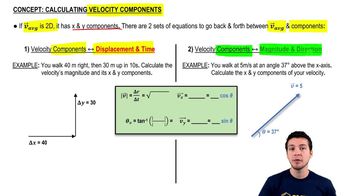
Calculating Velocity Components

Graph Interpretation

Graphs of velocity versus time provide visual representations of how an object's velocity changes over time. In this case, the x-component graph shows a constant velocity of -3 m/s, indicating motion to the left, while the y-component graph shows a linear decrease from 5 m/s to 0 m/s, indicating a change in vertical motion. Analyzing these graphs helps in determining the object's trajectory at specific time intervals.
Recommended video:
Guided course
07:32
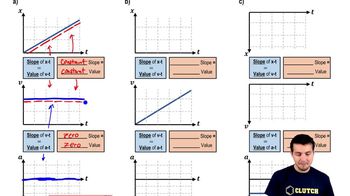
Graphing Position, Velocity, and Acceleration Graphs

Direction of Motion

The direction of motion can be expressed as an angle relative to a reference axis, typically the x-axis. This angle can be calculated using the arctangent function, which relates the y-component to the x-component of velocity. By determining the signs and magnitudes of these components at a given time, one can find the angle of the puck's motion, which is essential for understanding its trajectory.
Recommended video: