

Ch 29: The Magnetic Field
Knight Calc - Physics for Scientists and Engineers 5th Edition
Knight Calc5th EditionPhysics for Scientists and EngineersISBN: 9780137344796Not the one you use?Change textbook
Chapter 29, Problem 79

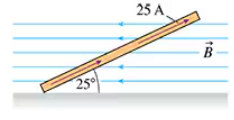
FIGURE CP29.79 is an edge view of a 2.0 kg square loop, 2.5 m on each side, with its lower edge resting on a frictionless, horizontal surface. A 25 A current is flowing around the loop in the direction shown. What is the strength of a uniform, horizontal magnetic field for which the loop is in static equilibrium at the angle shown?

Verified step by step guidance
1
Step 1: Analyze the forces acting on the square loop. The loop is in static equilibrium, meaning the net force and net torque acting on it must be zero. The forces include the gravitational force acting downward, the magnetic force due to the current in the loop, and the normal force from the surface.
Step 2: Calculate the gravitational force acting on the loop. The mass of the loop is 2.0 kg, so the gravitational force is given by \( F_g = m \cdot g \), where \( g \) is the acceleration due to gravity (approximately \( 9.8 \, \text{m/s}^2 \)).
Step 3: Determine the magnetic force acting on the loop. The magnetic force on a current-carrying wire is given by \( F_B = I \cdot L \cdot B \cdot \sin(\theta) \), where \( I \) is the current, \( L \) is the length of the wire, \( B \) is the magnetic field strength, and \( \theta \) is the angle between the wire and the magnetic field.
Step 4: Set up the torque equilibrium condition. The loop is tilted at an angle of 25° with respect to the horizontal. The torque due to the magnetic force must balance the torque due to the gravitational force. Use the lever arm distances and trigonometric relationships to express the torques mathematically.
Step 5: Solve for the magnetic field strength \( B \). Combine the equations for force and torque equilibrium, substituting known values (mass, current, length, angle, and gravitational acceleration) to isolate \( B \).

Verified video answer for a similar problem:

This video solution was recommended by our tutors as helpful for the problem above.
Was this helpful?

Key Concepts

Here are the essential concepts you must grasp in order to answer the question correctly.

Magnetic Force on a Current-Carrying Conductor

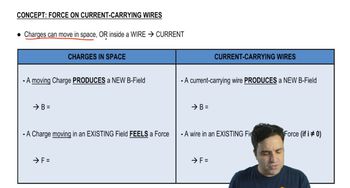
When a current-carrying conductor is placed in a magnetic field, it experiences a magnetic force. This force is given by the equation F = I * L * B * sin(θ), where F is the force, I is the current, L is the length of the conductor in the magnetic field, B is the magnetic field strength, and θ is the angle between the conductor and the magnetic field. This principle is crucial for understanding how the loop interacts with the magnetic field.
Recommended video:
Guided course
09:57
Magnetic Force on Current-Carrying Wire

Static Equilibrium

Static equilibrium occurs when an object is at rest and the net force and net torque acting on it are both zero. For the square loop in the problem, this means that the magnetic force acting on it must balance the gravitational force. Understanding static equilibrium is essential for determining the conditions under which the loop remains in a stable position at the given angle.
Recommended video:
Guided course
08:11
Static Friction & Equilibrium

Torque

Torque is a measure of the rotational force acting on an object and is calculated as τ = r * F * sin(φ), where τ is the torque, r is the distance from the pivot point to the point of force application, F is the force, and φ is the angle between the force vector and the lever arm. In this scenario, the torque generated by the magnetic force on the loop must be balanced by the torque due to the weight of the loop to maintain static equilibrium.
Recommended video:
Guided course
08:55
Net Torque & Sign of Torque
Related Practice
Textbook Question

An infinitely wide flat sheet of charge flows out of the figure in FIGURE CP29.83. The current per unit width along the sheet (amps per meter) is given by the linear current density Js. Find the magnetic field strength at distance d above or below the current sheet.

2
views
Textbook Question

A long, straight conducting wire of radius R has a nonuniform current density J = J₀r/R, where J₀ is a constant. The wire carries total current I. Find an expression for the magnetic field strength inside the wire at radius r.

1
views
Textbook Question

A scientist measuring the resistivity of a new metal alloy left her ammeter in another lab, but she does have a magnetic field probe. So she creates a 6.5-m-long, 2.0-mm-diameter wire of the material, connects it to a 1.5 V battery, and measures a 3.0 mT magnetic field 1.0 mm from the surface of the wire. What is the material's resistivity?

1
views
Textbook Question

A wire along the x-axis carries current I in the negative x-direction through the magnetic field B={B0xlk^0xl0elsewhere\(\vec{B}\)= \(\begin{cases}\) B_0\(\dfrac{x}{l}\]\hat{k}\) & 0 \(\leq\) x \(\leq\) l \\ 0 & \(\text{elsewhere}\) \(\end{cases}\). Find an expression for the net torque on the wire about the point x = 0.

1
views
Textbook Question

Determine the field strength at the center of a current-carrying square loop having sides of length 2R.

1
views
Textbook Question

An electromagnetic rail gun uses magnetic forces to launch projectiles. FIGURE P29.76 shows a 10-cm-long, 10 g metal wire that can slide without friction along 1.0-m-long horizontal rails. The rails are connected to a 300 V source, and a 0.10 T magnetic field fills the space between the rails. Each rail has linear resistivity ⋋ = 0.10 Ω/m, which means that the resistance is ⋋ multiplied by the length of rail through which current flows. Assume that the sliding wire and the left end, where the voltage source is, have zero resistance. The wire is initially placed at x₀ = 5.0 cm then the switch is closed. What is the wire's speed as it leaves the rails?

1
views