

Ch 29: The Magnetic Field
Knight Calc - Physics for Scientists and Engineers 5th Edition
Knight Calc5th EditionPhysics for Scientists and EngineersISBN: 9780137344796Not the one you use?Change textbook
Chapter 29, Problem 81b

Determine the field strength at the center of a current-carrying square loop having sides of length 2R.

Verified step by step guidance
1
Understand the problem: We are tasked with finding the magnetic field strength at the center of a square loop carrying a current. The loop has sides of length 2R, and the current in the loop is assumed to be steady. The Biot-Savart law or Ampère's law will be used to calculate the magnetic field contribution from each side of the loop.
Break the square loop into four straight segments. Each segment contributes to the magnetic field at the center of the square. Due to symmetry, the contributions from all four sides will add up vectorially. The magnetic field at the center due to a single straight segment can be calculated using the Biot-Savart law.
Apply the Biot-Savart law for a straight current-carrying wire segment. The magnetic field at a point due to a straight wire segment is given by: B = ( 1 / 4 π μ ) ( I × dl × r )/ r 3 where I is the current, dl is the infinitesimal length of the wire, and r is the distance from the wire to the point of interest.
Simplify the Biot-Savart law for the geometry of the square loop. At the center of the square, the distance from each segment to the center is the same, and the angle subtended by the wire at the center is symmetric. The magnetic field due to one side of the square is given by: B = ( 2 μ I / ( π R 2 ) where R is the distance from the center to the midpoint of the wire.
Combine the contributions from all four sides. Since the magnetic field contributions from each side are equal in magnitude and symmetrically directed, the total magnetic field at the center is four times the contribution from one side. Use the formula derived in the previous step to calculate the total field strength: B = 4 × ( 2 μ I / ( π R 2 ) .

Verified video answer for a similar problem:

This video solution was recommended by our tutors as helpful for the problem above.
Was this helpful?

Key Concepts

Here are the essential concepts you must grasp in order to answer the question correctly.

Magnetic Field Due to a Current-Carrying Wire

A current-carrying wire generates a magnetic field around it, described by the right-hand rule. The strength of this magnetic field at a distance from the wire depends on the current flowing through it and the distance from the wire. For a straight wire, the magnetic field strength (B) can be calculated using the formula B = (μ₀I)/(2πr), where μ₀ is the permeability of free space, I is the current, and r is the distance from the wire.
Recommended video:
Guided course
09:57
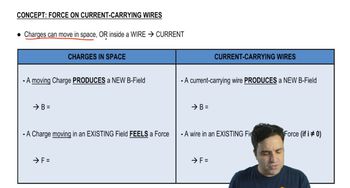
Magnetic Force on Current-Carrying Wire

Superposition of Magnetic Fields

The principle of superposition states that the total magnetic field at a point is the vector sum of the magnetic fields produced by each segment of the current-carrying loop. In the case of a square loop, each side contributes to the magnetic field at the center, and these contributions must be calculated and combined to find the net field strength.
Recommended video:
Guided course
05:30
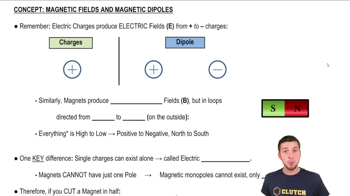
Magnetic Fields and Magnetic Dipoles

Magnetic Field at the Center of a Square Loop

For a square loop of side length 2R carrying a current I, the magnetic field at the center can be derived from the contributions of each side. The formula for the magnetic field at the center of a square loop is B = (2√2μ₀I)/(4πR), which accounts for the geometry of the loop and the distance from each side to the center. This result highlights how the configuration of the loop influences the resultant magnetic field.
Recommended video:
Guided course
13:54
Magnetic Field Produced by Loops and Solenoids
Related Practice
Textbook Question

An infinitely wide flat sheet of charge flows out of the figure in FIGURE CP29.83. The current per unit width along the sheet (amps per meter) is given by the linear current density Js. Find the magnetic field strength at distance d above or below the current sheet.

2
views
Textbook Question

A long, straight conducting wire of radius R has a nonuniform current density J = J₀r/R, where J₀ is a constant. The wire carries total current I. Find an expression for the magnetic field strength inside the wire at radius r.

1
views
Textbook Question

A scientist measuring the resistivity of a new metal alloy left her ammeter in another lab, but she does have a magnetic field probe. So she creates a 6.5-m-long, 2.0-mm-diameter wire of the material, connects it to a 1.5 V battery, and measures a 3.0 mT magnetic field 1.0 mm from the surface of the wire. What is the material's resistivity?

1
views
Textbook Question

A wire along the x-axis carries current I in the negative x-direction through the magnetic field B={B0xlk^0xl0elsewhere\(\vec{B}\)= \(\begin{cases}\) B_0\(\dfrac{x}{l}\]\hat{k}\) & 0 \(\leq\) x \(\leq\) l \\ 0 & \(\text{elsewhere}\) \(\end{cases}\). Find an expression for the net torque on the wire about the point x = 0.

1
views
Textbook Question

FIGURE CP29.79 is an edge view of a 2.0 kg square loop, 2.5 m on each side, with its lower edge resting on a frictionless, horizontal surface. A 25 A current is flowing around the loop in the direction shown. What is the strength of a uniform, horizontal magnetic field for which the loop is in static equilibrium at the angle shown?

1
views