Ch 30: Electromagnetic Induction
Knight Calc - Physics for Scientists and Engineers 5th Edition
Knight Calc5th EditionPhysics for Scientists and EngineersISBN: 9780137344796Not the one you use?Change textbook
Chapter 30, Problem 8

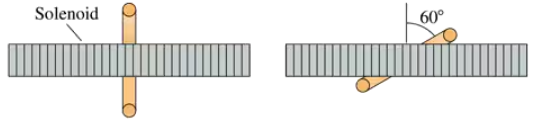
FIGURE EX30.8 shows a 2.0-cm-diameter solenoid passing through the center of a 6.0-cm-diameter loop. The magnetic field inside the solenoid is 0.20 T. What is the magnitude of the magnetic flux through the loop when it is perpendicular to the solenoid and when it is tilted at a 60° angle?

Verified step by step guidance
1
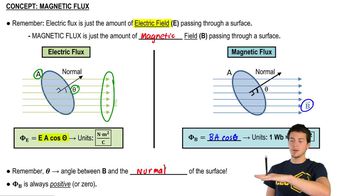
Step 1: Understand the concept of magnetic flux. Magnetic flux (Φ) is given by the formula Φ = B × A × cos(θ), where B is the magnetic field strength, A is the area through which the field passes, and θ is the angle between the magnetic field and the normal to the surface.
Step 2: Calculate the area of the solenoid cross-section. Since the solenoid has a diameter of 2.0 cm, its radius is 1.0 cm (or 0.01 m). The area of the solenoid cross-section is A_solenoid = π × r² = π × (0.01 m)².
Step 3: Determine the area of the loop. The loop has a diameter of 6.0 cm, so its radius is 3.0 cm (or 0.03 m). The area of the loop is A_loop = π × r² = π × (0.03 m)². However, only the area of the solenoid contributes to the flux through the loop because the solenoid is smaller and passes through the center of the loop.
Step 4: Calculate the magnetic flux when the loop is perpendicular to the solenoid. When the loop is perpendicular, θ = 0°, and cos(0°) = 1. Use the formula Φ = B × A_solenoid × cos(θ) to find the flux.
Step 5: Calculate the magnetic flux when the loop is tilted at a 60° angle. When the loop is tilted, θ = 60°, and cos(60°) = 0.5. Use the same formula Φ = B × A_solenoid × cos(θ), substituting θ = 60° to find the flux in this case.

Verified video answer for a similar problem:

This video solution was recommended by our tutors as helpful for the problem above.
Video duration:
12m
Was this helpful?

Key Concepts

Here are the essential concepts you must grasp in order to answer the question correctly.

Magnetic Flux

Magnetic flux is a measure of the quantity of magnetism, taking into account the strength and the extent of a magnetic field. It is defined as the product of the magnetic field (B) and the area (A) through which the field lines pass, and is given by the formula Φ = B · A · cos(θ), where θ is the angle between the magnetic field and the normal to the surface.
Recommended video:
Guided course
04:52
Magnetic Flux

Solenoid

A solenoid is a long coil of wire that generates a magnetic field when an electric current passes through it. The magnetic field inside a solenoid is uniform and can be calculated using the formula B = μ₀(nI), where μ₀ is the permeability of free space, n is the number of turns per unit length, and I is the current. The strength of the magnetic field is crucial for determining the magnetic flux through nearby loops.
Recommended video:
Guided course
11:47
Toroidal Solenoids aka Toroids

Angle of Inclination

The angle of inclination, or tilt angle, affects the calculation of magnetic flux through a surface. When the surface is perpendicular to the magnetic field, the angle θ is 0°, resulting in maximum flux. As the angle increases, the effective area through which the magnetic field lines pass decreases, which is accounted for in the flux calculation using the cosine of the angle, thus reducing the total magnetic flux.
Recommended video:
Guided course
08:27
Incline with Friction & Critical Angle