Ch 30: Electromagnetic Induction
Knight Calc - Physics for Scientists and Engineers 5th Edition
Knight Calc5th EditionPhysics for Scientists and EngineersISBN: 9780137344796Not the one you use?Change textbook
Chapter 30, Problem 9b

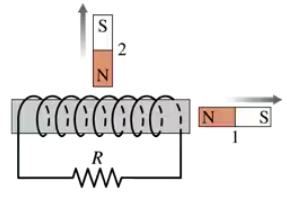
A solenoid is wound as shown in FIGURE EX30.9. Is there an induced current as magnet 2 is moved away from the solenoid? If so, what is the current direction through resistor R?

Verified step by step guidance
1
Step 1: Analyze the situation using Faraday's Law of Induction, which states that a changing magnetic flux through a loop induces an electromotive force (EMF) in the loop. Magnet 2 is moving away from the solenoid, which changes the magnetic flux through the solenoid.
Step 2: Determine the direction of the change in magnetic flux. As magnet 2 moves away, the magnetic field it contributes to the solenoid decreases. This reduction in magnetic flux induces a current in the solenoid to oppose the change, according to Lenz's Law.
Step 3: Apply Lenz's Law to find the direction of the induced current. The solenoid will generate a magnetic field to counteract the decrease in flux caused by magnet 2 moving away. To do this, the solenoid's induced magnetic field must point in the same direction as the field of magnet 2 (upward).
Step 4: Use the right-hand rule to determine the direction of the induced current in the solenoid. Curl the fingers of your right hand around the solenoid in the direction of the induced magnetic field (upward). Your fingers will point in the direction of the induced current in the solenoid.
Step 5: Trace the current through the circuit to determine its direction through resistor R. Based on the solenoid's winding and the induced current direction, the current flows through resistor R from left to right.

Verified video answer for a similar problem:

This video solution was recommended by our tutors as helpful for the problem above.
Was this helpful?

Key Concepts

Here are the essential concepts you must grasp in order to answer the question correctly.

Electromagnetic Induction

Electromagnetic induction is the process by which a changing magnetic field within a closed loop induces an electromotive force (EMF) in the wire. This phenomenon is described by Faraday's Law, which states that the induced EMF is proportional to the rate of change of the magnetic flux through the loop. In this scenario, as magnet 2 moves away from the solenoid, the magnetic flux through the solenoid changes, potentially inducing a current.
Recommended video:
Guided course
05:42
Introduction to Induction

Lenz's Law

Lenz's Law states that the direction of the induced current will be such that it opposes the change in magnetic flux that produced it. This means that if the magnetic field through the solenoid decreases (as magnet 2 moves away), the induced current will flow in a direction that attempts to maintain the original magnetic field. Understanding Lenz's Law is crucial for determining the direction of the induced current through resistor R.
Recommended video:

Current Direction in a Circuit

The direction of current flow in a circuit is determined by the orientation of the induced EMF and the components within the circuit. In this case, once the induced current is established due to the movement of magnet 2, it will flow through the resistor R. By applying the right-hand rule and considering the effects of Lenz's Law, one can deduce the specific direction of the current in the circuit.
Recommended video:
09:49
Direction of Current in Loop Equations