Ch 36: Special Relativity
Knight Calc - Physics for Scientists and Engineers 5th Edition
Knight Calc5th EditionPhysics for Scientists and EngineersISBN: 9780137344796Not the one you use?Change textbook
Chapter 36, Problem 46b

The star Alpha goes supernova. Ten years later and 100 ly away, as measured by astronomers in the galaxy, star Beta explodes. An alien spacecraft passing through the galaxy finds that the distance between the two explosions is 120 ly. According to the aliens, what is the time between the explosions?

Verified step by step guidance
1
Step 1: Recognize that this problem involves special relativity, specifically the concept of spacetime intervals. The spacetime interval (Δs²) is invariant between reference frames and is given by the equation: Δs² = Δx² - c²Δt², where Δx is the spatial separation, Δt is the time separation, and c is the speed of light.
Step 2: In the galaxy's reference frame, the spatial separation between the two explosions is 100 light-years (ly), and the time separation is 10 years. Calculate the spacetime interval in the galaxy's frame using: Δs² = (100 \, \(\text{ly}\))² - (c \, \(\cdot\) \, 10 \, \(\text{years}\))². Note that c = 1 ly/year in natural units.
Step 3: In the alien spacecraft's reference frame, the spatial separation is given as 120 ly. Since the spacetime interval is invariant, use the same equation: Δs² = (120 \, \(\text{ly}\))² - c²Δt'², where Δt' is the time separation in the alien's frame. Set this equal to the spacetime interval calculated in Step 2.
Step 4: Solve for Δt' in the alien's frame. Rearrange the equation: c²Δt'² = (120 \, \(\text{ly}\))² - Δs². Take the square root to find: Δt' = \(\sqrt{\frac{(120 \, \text{ly}\))² - Δs²}{c²}}. Substitute the value of Δs² from Step 2.
Step 5: Simplify the expression to find the time separation Δt' in the alien's frame. Ensure all units are consistent (e.g., using natural units where c = 1 ly/year). This will give the time between the explosions as measured by the aliens.

Verified video answer for a similar problem:

This video solution was recommended by our tutors as helpful for the problem above.
Was this helpful?

Key Concepts

Here are the essential concepts you must grasp in order to answer the question correctly.

Light Year

A light year is a unit of distance that represents how far light travels in one year, approximately 5.88 trillion miles (9.46 trillion kilometers). In the context of astronomy, it is used to measure vast distances between celestial objects. Understanding light years is crucial for interpreting the distances mentioned in the question, as it helps to relate the time taken for light to travel from one event to another.
Recommended video:
10:30
Ray Nature of Light

Supernova

A supernova is a powerful and luminous explosion that occurs at the end of a star's life cycle, often resulting in the star's destruction. This event releases an enormous amount of energy and can outshine entire galaxies for a short period. Recognizing the significance of supernovae is essential for understanding the timeline of events in the question, as it marks the starting point for measuring the time until the next explosion.

Relativity of Simultaneity

The relativity of simultaneity is a concept from Einstein's theory of relativity, which states that events that are simultaneous in one frame of reference may not be simultaneous in another. This principle is important in the context of the question, as the alien spacecraft measures the time between the two explosions differently than observers on Earth, due to the finite speed of light and the distances involved.
Recommended video:
Guided course
04:27
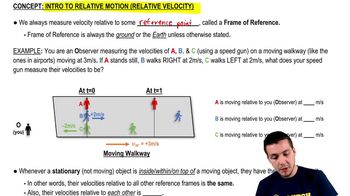
Intro to Relative Motion (Relative Velocity)
Related Practice
Textbook Question

Two events in reference frame S occur 10 μs apart at the same point in space. The distance between the two events is 2400 m in reference frame S'. What is the velocity of S' relative to S?

Textbook Question

A quarter-pound hamburger with all the fixings has a mass of 200 g. The food energy of the hamburger (480 food calories) is 2 MJ. By what factor does the energy equivalent exceed the food energy?

1
views
Textbook Question

The Stanford Linear Accelerator (SLAC) accelerates electrons to v = 0.99999997c in a 3.2-km-long tube. If they travel the length of the tube at full speed (they don’t, because they are accelerating), how long is the tube in the electrons’ reference frame?

1
views
Textbook Question

In an attempt to reduce the extraordinarily long travel times for voyaging to distant stars, some people have suggested traveling at close to the speed of light. Suppose you wish to visit the red giant star Betelgeuse, which is 430 ly away, and that you want your 20,000 kg rocket to move so fast that you age only 20 years during the round trip. How fast, as a fraction of c, must the rocket travel relative to earth?

1
views
Textbook Question

The star Delta goes supernova. One year later and 2.0 ly away, as measured by astronomers in the galaxy, star Epsilon explodes. Let the explosion of Delta be at xD = 0 and tD = 0. The explosions are observed by three spaceships cruising through the galaxy in the direction from Delta to Epsilon at velocities v1 = 0.30c, v2 = 0.50c, and v3 = 0.70c. All three spaceships, each at the origin of its reference frame, happen to pass Delta as it explodes. What are the times of the two explosions as measured by scientists on each of the three spaceships?

1
views
Textbook Question

A modest supernova (the explosion of a massive star at the end of its life cycle) releases 1.5 x 10⁴⁴ J of energy in a few seconds. This is enough to outshine the entire galaxy in which it occurs. Suppose a star with the mass of our sun collides with an antimatter star of equal mass, causing complete annihilation. What is the ratio of the energy released in this star-antistar collision to the energy released in the supernova?