
A merry-go-round with a moment of inertia equal to 860 kg·m² and a radius of 3.0 m rotates with negligible friction at 1.70 rad/s. A child initially standing still next to the merry-go-round jumps onto the edge of the platform straight toward the axis of rotation causing the platform to slow to 1.25 rad/s. What is her mass?
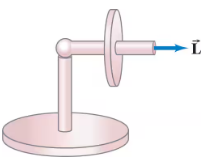
A toy gyroscope consists of a 170-g disk with a radius of 5.5 cm mounted at the center of a thin axle 21 cm long (Fig. 11–42). The gyroscope spins at 45 rev/s. One end of its axle rests on a stand and the other end precesses horizontally about the stand. How long does it take the gyroscope to precess once around?

Verified step by step guidance
Verified video answer for a similar problem:
Key Concepts
Gyroscopic Precession
Angular Momentum
Period of Precession
On a level billiards table a cue ball, initially at rest at point O on the table, is struck so that it leaves the cue stick with a center-of-mass speed v₀ and ω₀ a “reverse” spin of angular speed (see Fig. 11–41). A kinetic friction force acts on the ball as it initially skids across the table. If ω₀ is 10% smaller than ωC , i.e., ω₀ = 0.90ωC, determine the ball’s cm velocity vCM when it starts to roll without slipping.
Suppose a 5.2 x 10¹⁰kg meteorite struck the Earth at the equator with a speed v = 2.2 x 10⁴ m/s, as shown in Fig. 11–38 and remained stuck. By what factor would this affect the rotational frequency of the Earth (1 rev/day)?
<IMAGE>
On a level billiards table a cue ball, initially at rest at point O on the table, is struck so that it leaves the cue stick with a center-of-mass speed v₀ and ω₀ a “reverse” spin of angular speed (see Fig. 11–41). A kinetic friction force acts on the ball as it initially skids across the table. Using conservation of angular momentum, find the critical angular speed ωC such that, if ω₀=ωC, kinetic friction will bring the ball to a complete (as opposed to momentary) stop.
The time-dependent position of a point object which moves counterclockwise along the circumference of a circle (radius R) in the xy plane with constant speed υ is given by = î R cos ωt + ĵ R sin ωt where the constant ω = v/R. Determine the velocity and angular velocity of this object and then show that these three vectors obey the relation.
Suppose the solid wheel of Fig. 11–42 has a mass of 260 g and rotates at 85 rad/s; it has radius 6.0 cm and is mounted at the center of a horizontal thin axle 25 cm long. At what rate does the axle precess?
