
Ch. 11 - Angular Momentum; General Rotation
Giancoli Douglas - Physics for Scientists and Engineers 5th edition
Giancoli Douglas5th editionPhysics for Scientists and EngineersISBN: 9780137488179Not the one you use?Change textbook
Chapter 11, Problem 50

Suppose a 5.2 x 10¹⁰kg meteorite struck the Earth at the equator with a speed v = 2.2 x 10⁴ m/s, as shown in Fig. 11–38 and remained stuck. By what factor would this affect the rotational frequency of the Earth (1 rev/day)?
<IMAGE>

Verified step by step guidance
1
Understand the problem: The meteorite collides with the Earth and sticks to it, which means this is an inelastic collision. The goal is to determine how the Earth's rotational frequency changes due to the added angular momentum from the meteorite.
Step 1: Calculate the initial angular momentum of the meteorite. Angular momentum is given by \( L = mvr \), where \( m \) is the mass of the meteorite, \( v \) is its velocity, and \( r \) is the Earth's radius at the equator. Use the Earth's radius \( r = 6.37 \times 10^6 \; \text{m} \).
Step 2: Determine the Earth's initial angular momentum. The Earth's angular momentum is given by \( L = I \omega \), where \( I \) is the moment of inertia of a sphere rotating about its axis (\( I = \frac{2}{5}MR^2 \), with \( M \) being the Earth's mass and \( R \) its radius), and \( \omega \) is the angular velocity (related to the rotational frequency by \( \omega = 2\pi f \), where \( f = \frac{1}{\text{day}} \)).
Step 3: Apply conservation of angular momentum. The total angular momentum before the collision (Earth's angular momentum + meteorite's angular momentum) equals the total angular momentum after the collision. Set up the equation: \( L_{\text{Earth, initial}} + L_{\text{meteorite}} = L_{\text{Earth, final}} \).
Step 4: Solve for the new rotational frequency. The final angular momentum is related to the new angular velocity \( \omega_{\text{final}} \), which can be converted to the new rotational frequency \( f_{\text{final}} \). The factor by which the rotational frequency changes is \( \frac{f_{\text{final}}}{f_{\text{initial}}} \).

Verified video answer for a similar problem:

This video solution was recommended by our tutors as helpful for the problem above.
Video duration:
10m
Was this helpful?

Key Concepts

Here are the essential concepts you must grasp in order to answer the question correctly.

Conservation of Angular Momentum

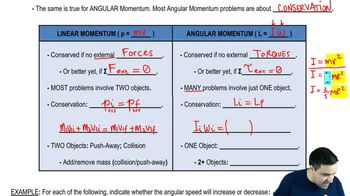
The conservation of angular momentum states that in a closed system with no external torques, the total angular momentum remains constant. When the meteorite strikes the Earth and becomes part of it, the system's angular momentum before and after the impact must be equal. This principle is crucial for determining how the addition of the meteorite affects the Earth's rotational frequency.
Recommended video:
Guided course
12:12
Conservation of Angular Momentum

Rotational Frequency

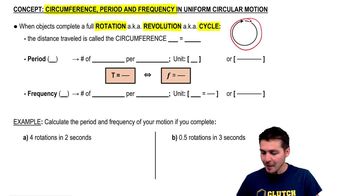
Rotational frequency refers to the number of complete rotations an object makes in a given time period, typically expressed in revolutions per day (rev/day). For Earth, this is approximately one rotation per day. When mass is added to a rotating body, its rotational frequency can change, which is essential for calculating the new frequency after the meteorite's impact.
Recommended video:
Guided course
05:08
Circumference, Period, and Frequency in UCM

Moment of Inertia

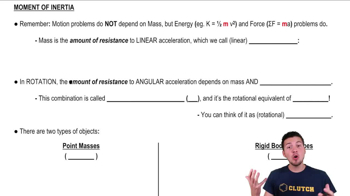
The moment of inertia is a measure of an object's resistance to changes in its rotational motion, depending on the mass distribution relative to the axis of rotation. When the meteorite strikes the Earth, it increases the total moment of inertia of the Earth-meteorite system. Understanding how this change affects the rotational frequency is key to solving the problem.
Recommended video:
Guided course
11:47
Intro to Moment of Inertia
Related Practice
Textbook Question

A toy gyroscope consists of a 170-g disk with a radius of 5.5 cm mounted at the center of a thin axle 21 cm long (Fig. 11–42). The gyroscope spins at 45 rev/s. One end of its axle rests on a stand and the other end precesses horizontally about the stand. How long does it take the gyroscope to precess once around?

1
views
Textbook Question

Two ice skaters, both of mass 68 kg, approach on parallel paths 1.6 m apart. Both are moving at 3.5 m/s with their arms outstretched. They join hands as they pass, still maintaining their 1.6-m separation, and begin rotating about one another. Treat the skaters as particles with regard to their rotational inertia. If they now pull on each other’s hands, reducing their radius to half its original value, what is their common angular speed after reducing their radius?

1
views
Textbook Question

On a level billiards table a cue ball, initially at rest at point O on the table, is struck so that it leaves the cue stick with a center-of-mass speed v₀ and ω₀ a “reverse” spin of angular speed (see Fig. 11–41). A kinetic friction force acts on the ball as it initially skids across the table. If ω₀ is 10% smaller than ωC , i.e., ω₀ = 0.90ωC, determine the ball’s cm velocity vCM when it starts to roll without slipping.

2
views
Textbook Question

Two ice skaters, both of mass 68 kg, approach on parallel paths 1.6 m apart. Both are moving at 3.5 m/s with their arms outstretched. They join hands as they pass, still maintaining their 1.6-m separation, and begin rotating about one another. Treat the skaters as particles with regard to their rotational inertia. Calculate the change in kinetic energy for this process.

2
views
Textbook Question

Two ice skaters, both of mass 68 kg, approach on parallel paths 1.6 m apart. Both are moving at 3.5 m/s with their arms outstretched. They join hands as they pass, still maintaining their 1.6-m separation, and begin rotating about one another. Treat the skaters as particles with regard to their rotational inertia. They now pull on each other’s hands, reducing their radius to half its original value. Calculate the change in kinetic energy for this process.

2
views
Textbook Question

On a level billiards table a cue ball, initially at rest at point O on the table, is struck so that it leaves the cue stick with a center-of-mass speed v₀ and ω₀ a “reverse” spin of angular speed (see Fig. 11–41). A kinetic friction force acts on the ball as it initially skids across the table. Using conservation of angular momentum, find the critical angular speed ωC such that, if ω₀=ωC, kinetic friction will bring the ball to a complete (as opposed to momentary) stop.

2
views