Ch 15: Mechanical Waves
Young & Freedman Calc - University Physics 14th Edition
Young & Freedman Calc14th EditionUniversity PhysicsISBN: 9780321973610Not the one you use?Change textbook
Chapter 15, Problem 28fg

A fellow student with a mathematical bent tells you that the wave function of a traveling wave on a thin rope is y(x,t)=(2.30mm)cos[(16.98 rad/m)x+(742 rad/s)t]y(x,t)=\(\left\)(2.30\(\operatorname{mm)}\]\cos\)[\(\left\)(16.98\(\text{ }\)rad/m\(\right\))x+(742\(\text{ }\)rad/s\(\right\))t]. Being more practical, you measure the rope to have a length of 1.35 m1.35\(\text{ m}\) and a mass of 0.00338kg0.00338\(\operatorname{kg}\). You are then asked to determine the following: (f) tension in the rope; (g) average power transmitted by the wave.

Verified step by step guidance
1
Step 1: Identify the wave function given in the problem: y(x, t) = 2.30 mm cos[(16.98 rad/m)x + (742 rad/s)t]. This function describes a traveling wave on a rope.
Step 2: Calculate the wave speed (v) using the wave number (k) and angular frequency (ω). The wave number k is 16.98 rad/m, and the angular frequency ω is 742 rad/s. Use the formula v = ω/k to find the wave speed.
Step 3: Determine the linear mass density (μ) of the rope. The linear mass density is the mass per unit length of the rope. Use the formula μ = mass/length, where the mass is 0.00338 kg and the length is 1.35 m.
Step 4: Calculate the tension (T) in the rope using the wave speed and linear mass density. The formula for tension is T = μv², where μ is the linear mass density and v is the wave speed calculated in Step 2.
Step 5: Calculate the average power (P) transmitted by the wave. Use the formula P = (1/2)μvω²A², where A is the amplitude of the wave (2.30 mm converted to meters), μ is the linear mass density, v is the wave speed, and ω is the angular frequency.

Verified video answer for a similar problem:

This video solution was recommended by our tutors as helpful for the problem above.
Video duration:
9m
Was this helpful?

Key Concepts

Here are the essential concepts you must grasp in order to answer the question correctly.

Wave Function

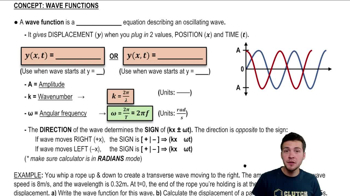
The wave function y(x, t) = 2.30mm cos[(16.98 rad/m)x + (742 rad/s)t] describes the displacement of a wave at position x and time t. It includes parameters like amplitude, wave number, and angular frequency, which are crucial for understanding wave behavior and calculating properties like speed and energy.
Recommended video:
Guided course
08:30
Intro to Wave Functions

Tension in the Rope

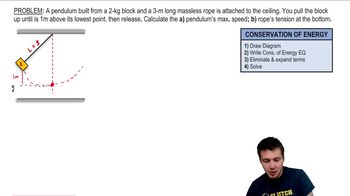
Tension in the rope is a force that affects wave propagation speed. It can be calculated using the formula v = sqrt(T/μ), where v is the wave speed, T is the tension, and μ is the linear mass density (mass per unit length). Understanding tension is essential for determining how fast waves travel along the rope.
Recommended video:
Guided course
06:34
Calculating Tension in a Pendulum with Energy Conservation

Average Power Transmitted by the Wave

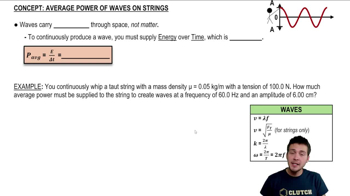
The average power transmitted by a wave is the rate at which energy is transferred along the medium. It can be calculated using P_avg = (1/2)μω^2A^2v, where μ is the linear mass density, ω is the angular frequency, A is the amplitude, and v is the wave speed. This concept helps in understanding the energy dynamics of wave motion.
Recommended video:
Guided course
04:39
Energy & Power of Waves on Strings
Related Practice
Textbook Question

Two pulses are moving in opposite directions at 1.0 cm/s on a taut string, as shown in Fig. E15.34. Each square is 1.0 cm.

<Image>

Sketch the shape of the string at the end of 6.0 s.

1
views
Textbook Question

A fellow student with a mathematical bent tells you that the wave function of a traveling wave on a thin rope is y(x,t)=(2.30mm)cos[(16.98 rad/m)x+(742 rad/s)t]y(x,t)=\(\left\)(2.30\(\operatorname{mm)}\]\cos\)[\(\left\)(16.98\(\text{ }\)rad/m\(\right\))x+(742\(\text{ }\)rad/s\(\right\))t]. Being more practical, you measure the rope to have a length of 1.35 m1.35\(\text{ m}\) and a mass of 0.00338kg0.00338\(\operatorname{kg}\). You are then asked to determine the following: (d) wave speed; (e) direction the wave is traveling;

1
views
Textbook Question

At a distance of 7.00 x 10¹² m from a star, the intensity of the radiation from the star is 15.4 W/m2. Assuming that the star radiates uniformly in all directions, what is the total power output of the star?

1
views
Textbook Question

A fellow student with a mathematical bent tells you that the wave function of a traveling wave on a thin rope is y(x,t)=(2.30mm)cos[(16.98 rad/m)x+(742 rad/s)t]y(x,t)=\(\left\)(2.30\(\operatorname{mm)}\]\cos\)[\(\left\)(16.98\(\text{ }\)rad/m\(\right\))x+(742\(\text{ }\)rad/s\(\right\))t]. Being more practical, you measure the rope to have a length of 1.35 m1.35\(\text{ m}\) and a mass of 0.00338kg0.00338\(\operatorname{kg}\). You are then asked to determine the following: (a) amplitude; (b) frequency; (c) wavelength.

1
views
Textbook Question

Two pulses are moving in opposite directions at 1.0 cm/s on a taut string, as shown in Fig. E15.34. Each square is 1.0 cm. <IMAGE> Sketch the shape of the string at the end of 7.0 s.

2
views
Textbook Question

Energy Output. By measurement you determine that sound waves are spreading out equally in all directions from a point source and that the intensity is 0.026 W/m2 at a distance of 4.3 m from the source. How much sound energy does the source emit in one hour if its power output remains constant?

3
views