Ch 09: Rotation of Rigid Bodies
Young & Freedman Calc - University Physics 14th Edition
Young & Freedman Calc14th EditionUniversity PhysicsISBN: 9780321973610Not the one you use?Change textbook
Chapter 9, Problem 47a

If we multiply all the design dimensions of an object by a scaling factor f, its volume and mass will be multiplied by f3. By what factor will its moment of inertia be multiplied?

Verified step by step guidance
1
Understand the relationship between the moment of inertia and mass distribution: The moment of inertia (I) depends on both the mass (m) of the object and the square of the distance (r²) of the mass elements from the axis of rotation. Mathematically, it is expressed as I = ∫r² dm.
Analyze the effect of scaling on the mass: When all dimensions of the object are scaled by a factor f, the volume increases by f³. Assuming the density remains constant, the mass of the object will also increase by a factor of f³.
Analyze the effect of scaling on the distance: Since all linear dimensions are scaled by a factor f, the distance r of each mass element from the axis of rotation will also be scaled by f.
Combine the effects of scaling on mass and distance: The moment of inertia involves the product of mass and the square of the distance (r²). When the mass is scaled by f³ and the distance is scaled by f, the square of the distance (r²) will be scaled by f². Therefore, the moment of inertia will be scaled by f³ × f² = f⁵.
Conclude the scaling factor for the moment of inertia: The moment of inertia of the object will be multiplied by a factor of f⁵ when all its dimensions are scaled by a factor of f.

Verified video answer for a similar problem:

This video solution was recommended by our tutors as helpful for the problem above.
Video duration:
7m
Was this helpful?

Key Concepts

Here are the essential concepts you must grasp in order to answer the question correctly.

Scaling Factor

A scaling factor is a numerical value used to increase or decrease the size of an object in a proportional manner. When all dimensions of an object are multiplied by a scaling factor 'f', it affects the object's geometric properties, such as volume and surface area, in a predictable way. For instance, if the length, width, and height of a cube are each multiplied by 'f', the new volume becomes f^3 times the original volume.
Recommended video:
Guided course
04:54
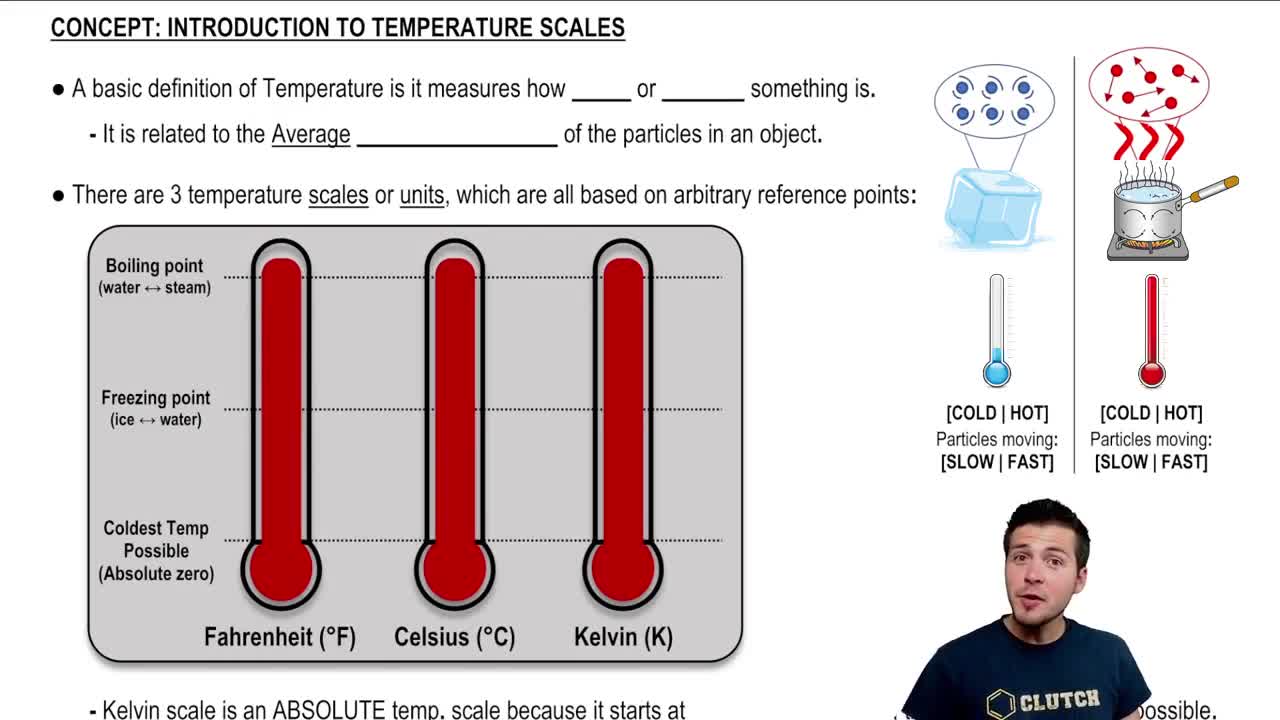
Introduction To Temperature Scales

Moment of Inertia

The moment of inertia is a measure of an object's resistance to rotational motion about an axis. It depends on the mass distribution relative to that axis; the further the mass is from the axis, the greater the moment of inertia. When scaling an object, the moment of inertia is affected by the square of the scaling factor, specifically multiplied by f^2, since it involves the mass and the square of the distance from the axis of rotation.
Recommended video:
Guided course
11:47
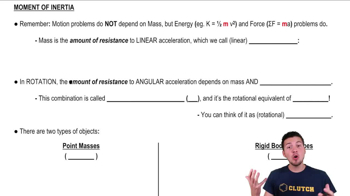
Intro to Moment of Inertia

Mass and Volume Relationship

The relationship between mass and volume is fundamental in physics, particularly in understanding density. When an object's dimensions are scaled, its volume changes according to the cube of the scaling factor, while its mass changes proportionally if the material remains the same. This relationship is crucial for calculating how other properties, like moment of inertia, will change when the object's size is altered.
Recommended video:
Guided course
05:21
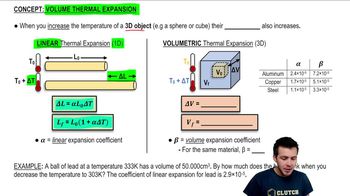
Volume Thermal Expansion
Related Practice
Textbook Question

A thin, rectangular sheet of metal has mass M and sides of length a and b. Use the parallel-axis theorem to calculate the moment of inertia of the sheet for an axis that is perpendicular to the plane of the sheet and that passes through one corner of the sheet.

1
views
Textbook Question

A uniform sphere with mass 28.028.0 kg and radius 0.3800.380 m is rotating at constant angular velocity about a stationary axis that lies along a diameter of the sphere. If the kinetic energy of the sphere is 236236 J, what is the tangential velocity of a point on the rim of the sphere?

1
views
Textbook Question

A uniform 2.00-m ladder of mass 9.00 kg is leaning against a vertical wall while making an angle of 53.0° with the floor. A worker pushes the ladder up against the wall until it is vertical. What is the increase in the gravitational potential energy of the ladder?

2
views
Textbook Question

Find the moment of inertia of a hoop (a thin-walled, hollow ring) with mass M and radius R about an axis perpendicular to the hoop's plane at an edge.

3
views
Textbook Question

The flywheel of a gasoline engine is required to give up 500 J of kinetic energy while its angular velocity decreases from 650 rev/min to 520 rev/min. What moment of inertia is required?

1
views
Textbook Question

If we multiply all the design dimensions of an object by a scaling factor f, its volume and mass will be multiplied by f3. If a 1/48 scale model has a rotational kinetic energy of 2.5 J, what will be the kinetic energy for the full-scale object of the same material rotating at the same angular velocity?

1
views