
Two blocks are connected by a light string passing over a pulley of radius 0.15 m and moment of inertia I. The blocks move (towards the right) with an acceleration of 1.00 m/s² along their frictionless inclines (see Fig. 10–62). Find the net torque acting on the pulley, and determine its moment of inertia, I.
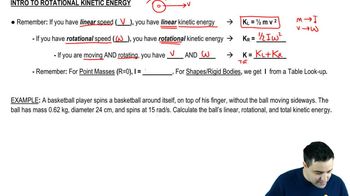
A bowling ball of mass 7.3 kg and radius 9.0 cm rolls without slipping down a lane at 3.7 m/s. Calculate its total kinetic energy.
Verified step by step guidance
Verified video answer for a similar problem:
Key Concepts
Kinetic Energy
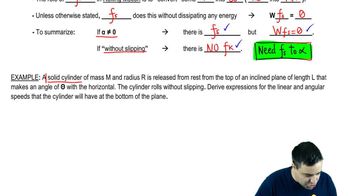
Rolling Motion
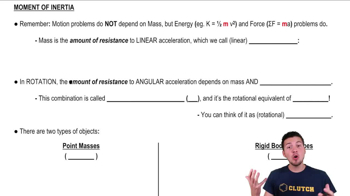
Moment of Inertia
A solid rubber ball rests on the floor of a railroad car when the car begins moving with acceleration a. Assuming the ball rolls without slipping, what is its acceleration relative to the car?
(III) Integrate to derive the formula for the moment of inertia of a uniform thin rod of length ℓ about an axis through its center, perpendicular to the rod (see Fig. 10–21f).
A 2.30-m-long pole is balanced vertically on its tip. It starts to fall and its lower end does not slip. What will be the speed of the upper end of the pole just before it hits the ground? [Hint: Use conservation of energy.]
A solid rubber ball rests on the floor of a railroad car when the car begins moving with acceleration a. Assuming the ball rolls without slipping, what is its acceleration relative to the ground?
II) A uniform solid sphere of radius r0 = 24.5 cm and mass m = 1.60 kg starts from rest and rolls without slipping down a 30.0° incline that is 10.0 m long. Calculate its translational and rotational speeds when it reaches the bottom. Avoid putting in numbers until the end so you can answer.
