Ch 16: Traveling Waves
Knight Calc - Physics for Scientists and Engineers 5th Edition
Knight Calc5th EditionPhysics for Scientists and EngineersISBN: 9780137344796Not the one you use?Change textbook
Chapter 16, Problem 36a

A concert loudspeaker suspended high above the ground emits 35 W of sound power. A small microphone with a 1.0 cm² area is 50 m from the speaker. What is the sound intensity at the position of the microphone?

Verified step by step guidance
1
Step 1: Understand the concept of sound intensity. Sound intensity (I) is defined as the sound power (P) per unit area (A). The formula for sound intensity is: I=PA. In this problem, the sound power is given as 35 W, and the microphone is located at a distance of 50 m from the speaker.
Step 2: Calculate the area of the sphere over which the sound power is distributed. Since the sound spreads uniformly in all directions, the area is the surface area of a sphere with radius equal to the distance from the speaker to the microphone. The formula for the surface area of a sphere is: A=4πr2, where r is the radius (distance).
Step 3: Substitute the given distance (50 m) into the formula for the surface area of the sphere. This will give the total area over which the sound power is distributed: A=4π502.
Step 4: Use the sound intensity formula to calculate the intensity at the position of the microphone. Substitute the sound power (35 W) and the calculated area of the sphere into the formula: I=35A, where A is the surface area of the sphere calculated in Step 3.
Step 5: Simplify the expression to find the sound intensity at the microphone's position. This will give the sound intensity in units of W/m². Note that the microphone's area (1.0 cm²) is not directly relevant for calculating the intensity, as intensity is defined as power per unit area over the sphere's surface.

Verified video answer for a similar problem:

This video solution was recommended by our tutors as helpful for the problem above.
Video duration:
3m
Was this helpful?

Key Concepts

Here are the essential concepts you must grasp in order to answer the question correctly.

Sound Intensity

Sound intensity is defined as the power per unit area carried by a sound wave. It is measured in watts per square meter (W/m²) and represents how much sound energy passes through a given area in a specific time. The intensity of sound decreases with distance from the source due to the spreading of sound waves.
Recommended video:
Guided course
04:25
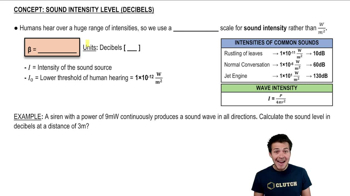
Sound Intensity Level and the Decibel Scale

Inverse Square Law

The inverse square law states that the intensity of a physical quantity (like sound) is inversely proportional to the square of the distance from the source. This means that as you move away from the sound source, the intensity decreases rapidly, specifically by a factor of the square of the distance. This principle is crucial for calculating sound intensity at different distances.
Recommended video:
Guided course
05:26
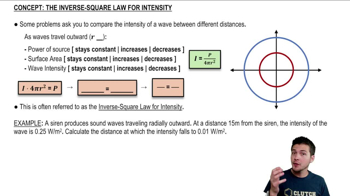
The Inverse-Square Law for Intensity

Area of the Microphone

The area of the microphone is important for determining how much sound power it can capture. In this case, the microphone has a specified area of 1.0 cm², which can be converted to square meters for calculations. The sound intensity at the microphone's location can be calculated by considering both the power emitted by the loudspeaker and the area over which that power is distributed.
Recommended video:
Guided course
04:05
Calculating Work As Area Under F-x Graphs