Ch. 02 - Describing Motion: Kinematics in One Dimension
Giancoli Douglas - Physics for Scientists and Engineers 5th edition
Giancoli Douglas5th editionPhysics for Scientists and EngineersISBN: 9780137488179Not the one you use?Change textbook
Chapter 2, Problem 27a

The position of an object is given by 𝓍 = At + Bt², where 𝓍 is in meters and t is in seconds. What are the units of A and B?

Verified step by step guidance
1
Step 1: Start by analyzing the given equation for position: 𝓍 = At + Bt². Here, 𝓍 represents position in meters (m), t represents time in seconds (s), and A and B are constants with unknown units.
Step 2: Focus on the term At. Since 𝓍 is in meters, the product At must also have units of meters. The unit of t is seconds (s), so the unit of A must be meters per second (m/s) to ensure the product At has units of meters.
Step 3: Now, consider the term Bt². Again, since 𝓍 is in meters, the product Bt² must also have units of meters. The unit of t² is seconds squared (s²), so the unit of B must be meters per second squared (m/s²) to ensure the product Bt² has units of meters.
Step 4: Summarize the findings: The unit of A is meters per second (m/s), and the unit of B is meters per second squared (m/s²).
Step 5: Verify the consistency of units in the equation: Substitute the derived units of A and B into the equation 𝓍 = At + Bt². Confirm that both terms At and Bt² have units of meters, ensuring the equation is dimensionally consistent.

Verified video answer for a similar problem:

This video solution was recommended by our tutors as helpful for the problem above.
Was this helpful?

Key Concepts

Here are the essential concepts you must grasp in order to answer the question correctly.

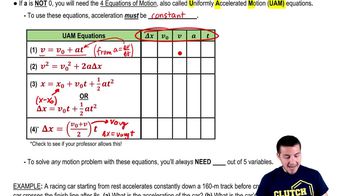
Kinematic Equations

Kinematic equations describe the motion of objects under constant acceleration. In this context, the equation 𝓍 = At + Bt² represents the position of an object as a function of time, where A and B are coefficients that influence the object's motion. Understanding these equations is essential for analyzing how position changes with time.
Recommended video:
Guided course
08:25
Kinematics Equations

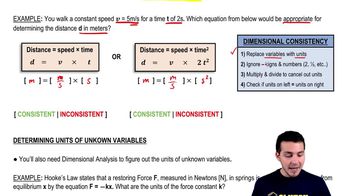
Dimensional Analysis

Dimensional analysis is a method used to convert units and check the consistency of equations. By analyzing the dimensions of each term in the equation, we can determine the units of A and B. This technique ensures that all terms in the equation are compatible, which is crucial for solving physics problems.
Recommended video:
Guided course
05:00
Dimensional Analysis

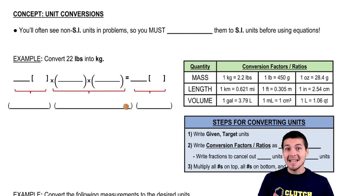
Units of Measurement

Units of measurement provide a standard for quantifying physical quantities. In this equation, 𝓍 is measured in meters (m) and time t in seconds (s). The units of A and B can be derived from the equation by ensuring that the terms on both sides have the same dimensions, leading to a clear understanding of their physical significance.
Recommended video:
Guided course
07:46
Unit Conversions