Ch. 02 - Describing Motion: Kinematics in One Dimension
Giancoli Douglas - Physics for Scientists and Engineers 5th edition
Giancoli Douglas5th editionPhysics for Scientists and EngineersISBN: 9780137488179Not the one you use?Change textbook
Chapter 2, Problem 19

A bowling ball traveling with constant speed hits the pins at the end of a bowling lane 16.5 m long. The bowler hears the sound of the ball hitting the pins 2.75 s after the ball is released from his hands. What is the speed of the ball, assuming the speed of sound is 340 m/s?

Verified step by step guidance
1
Step 1: Understand the problem. The total time given (2.75 s) includes the time it takes for the bowling ball to travel the 16.5 m lane and the time it takes for the sound of the ball hitting the pins to travel back to the bowler. We need to calculate the speed of the bowling ball.
Step 2: Define the variables. Let the speed of the bowling ball be v_ball (unknown). The speed of sound is given as 340 m/s. The distance traveled by the ball is 16.5 m, and the distance traveled by the sound is also 16.5 m.
Step 3: Write the equation for the total time. The total time (2.75 s) is the sum of the time taken by the ball to reach the pins and the time taken by the sound to travel back to the bowler. Mathematically, this can be expressed as: t=dv+dvsound, where t is the total time, d is the distance, v is the speed of the ball, and v_sound is the speed of sound.
Step 4: Substitute the known values into the equation. Replace t with 2.75 s, d with 16.5 m, and v_sound with 340 m/s. The equation becomes: 2.75=16.5v+16.5340.
Step 5: Solve for v_ball. Rearrange the equation to isolate v_ball. First, calculate the time taken by the sound: 16.5340. Subtract this value from 2.75 s to find the time taken by the ball. Then use the formula v=dt to calculate the speed of the ball.

Verified video answer for a similar problem:

This video solution was recommended by our tutors as helpful for the problem above.
Was this helpful?

Key Concepts

Here are the essential concepts you must grasp in order to answer the question correctly.

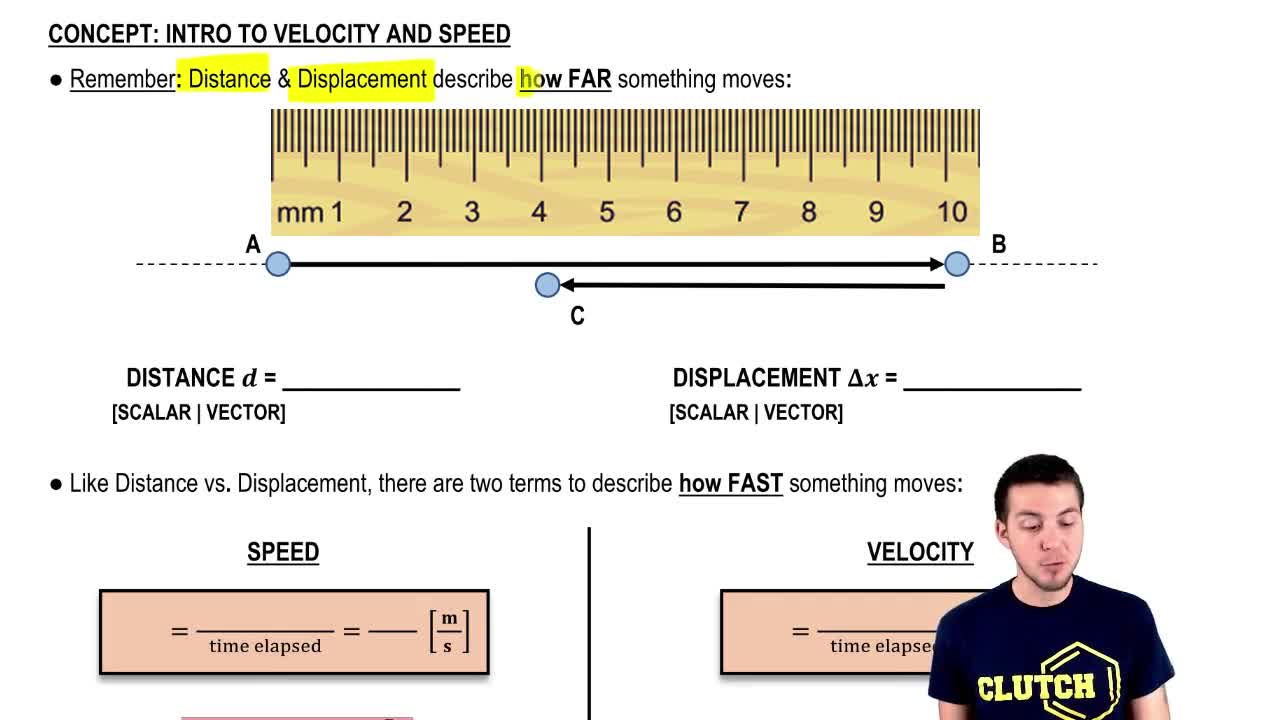
Speed and Velocity

Speed is a scalar quantity that refers to how fast an object is moving, defined as the distance traveled per unit of time. In this scenario, the bowling ball travels a distance of 16.5 meters, and understanding speed is crucial to calculate how long it takes to reach the pins. Velocity, on the other hand, includes direction, but since the ball travels in a straight line, we can focus on speed for this problem.
Recommended video:
Guided course
05:35
Intro to Velocity and Speed

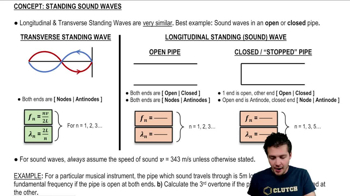
Sound Propagation

Sound travels through air at a specific speed, which is approximately 340 m/s at room temperature. In this question, the time it takes for the sound of the ball hitting the pins to reach the bowler is essential for determining the total time elapsed. Understanding how sound propagates helps in calculating the time taken for sound to travel back to the bowler after the impact.
Recommended video:
Guided course
05:17
Standing Sound Waves

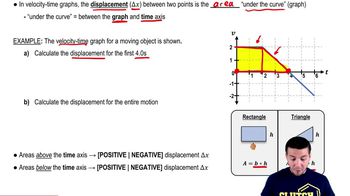
Time Calculation

Time is a critical factor in physics, often used to relate distance and speed. In this case, the total time from when the ball is released to when the sound is heard is 2.75 seconds. By breaking this time into the duration it takes for the ball to hit the pins and the time for the sound to travel back, we can derive the speed of the bowling ball using the formula: speed = distance/time.
Recommended video:
Guided course
04:43
Calculating Displacement from Velocity-Time Graphs