Ch. 24 - Capacitance, Dielectrics, Electric Energy, Storage
Giancoli Douglas - Physics for Scientists and Engineers 5th edition
Giancoli Douglas5th editionPhysics for Scientists and EngineersISBN: 9780137488179Not the one you use?Change textbook
Chapter 23, Problem 6

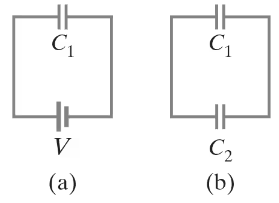
(II) A 7.7-μF capacitor is charged by a 185-V battery (Fig. 24–21a) and then is disconnected from the battery. When this capacitor (C₁) is then connected (Fig. 24–21b) to a second (initially uncharged) capacitor, C₂, the final voltage on each capacitor is 15 V. What is the value of C₂? [Hint: Charge is conserved.]

Verified step by step guidance
1
Step 1: Understand the problem. A charged capacitor (C₁) is disconnected from a battery and connected to an uncharged capacitor (C₂). The final voltage across both capacitors is 15 V. The key concept here is conservation of charge: the total charge before and after the connection remains the same.
Step 2: Write the expression for the initial charge on C₁. The charge on a capacitor is given by Q = C × V. For C₁, the initial charge is Q₁_initial = C₁ × V₁, where C₁ = 7.7 μF and V₁ = 185 V.
Step 3: Write the expression for the final charge on both capacitors. After the connection, the capacitors share the charge, and the final voltage across both is the same (V_final = 15 V). The total charge is distributed as Q₁_final = C₁ × V_final and Q₂_final = C₂ × V_final.
Step 4: Apply the conservation of charge principle. The total charge before the connection equals the total charge after the connection: Q₁_initial = Q₁_final + Q₂_final. Substitute the expressions for Q₁_initial, Q₁_final, and Q₂_final into this equation.
Step 5: Solve for C₂. Rearrange the equation from Step 4 to isolate C₂. The equation becomes C₂ = (Q₁_initial - Q₁_final) / V_final. Substitute the known values (C₁, V₁, and V_final) into the equation to calculate C₂.

Verified video answer for a similar problem:

This video solution was recommended by our tutors as helpful for the problem above.
Video duration:
4m
Was this helpful?

Key Concepts

Here are the essential concepts you must grasp in order to answer the question correctly.

Capacitance

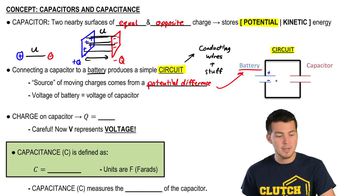
Capacitance is the ability of a capacitor to store charge per unit voltage, measured in farads (F). It is defined by the formula C = Q/V, where C is capacitance, Q is the charge stored, and V is the voltage across the capacitor. In this problem, the capacitance of the first capacitor (C₁) is given, which is essential for calculating the charge it holds when connected to the battery.
Recommended video:
Guided course
08:02
Capacitors & Capacitance (Intro)

Charge Conservation

Charge conservation is a fundamental principle stating that the total electric charge in an isolated system remains constant. When the charged capacitor C₁ is connected to the uncharged capacitor C₂, the charge from C₁ redistributes between the two capacitors. This principle allows us to set up an equation to find the unknown capacitance C₂ based on the initial and final conditions of the system.
Recommended video:
Guided course
05:43
Conservation of Charge

Voltage in Series Capacitors

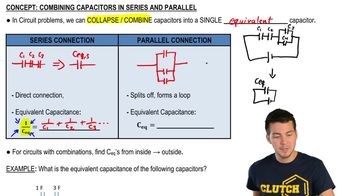
When capacitors are connected in parallel, the voltage across each capacitor is the same. In this scenario, after connecting C₁ and C₂, both capacitors reach a final voltage of 15 V. This relationship is crucial for solving the problem, as it allows us to equate the charge on C₁ before the connection to the total charge on both capacitors after they are connected, facilitating the calculation of C₂.
Recommended video:
Guided course
09:51
Combining Capacitors in Series & Parallel
Related Practice
Textbook Question

To get an idea how big a farad is, suppose you want to make a 1-F air-filled parallel-plate capacitor for a circuit you are building. To make it a reasonable size, suppose you limit the plate area to 1.0 cm². What would the gap have to be between the plates? Is this practically achievable?

1
views
Textbook Question

Small distances can be measured using a capacitor whose plate separation 𝓍 is variable. Consider an air-filled parallel-plate capacitor with fixed plate area A = 25 mm² separated by a variable distance 𝓍. Assume this capacitor is attached to a capacitance-measuring instrument which can measure capacitance C in the range 1.0 pF to 1000.0 pF with an accuracy of ∆C = 0.1 pF. Define ∆𝓍 to be the accuracy (magnitude) to which 𝓍 can be determined, and determine a formula for ∆𝓍.

2
views
Textbook Question

In an electrostatic air cleaner (“precipitator”), the strong nonuniform electric field in the central region of a cylindrical capacitor (with outer and inner cylindrical radii Rₐ and R₆ ) is used to create ionized air molecules for use in charging dust and soot particles (Fig. 24–22). Under standard atmospheric conditions, if air is subjected to an electric field magnitude that exceeds its dielectric strength Eₛ ≈ 3.0 x 10⁶ N/C, air molecules will dissociate into positively charged ions and free electrons. In a precipitator, the region within which air is ionized (the corona discharge region) occupies a cylindrical volume of radius R that is typically five times that of the inner cylinder. Assume a particular precipitator is constructed with R₆ = 0.10 mm and Rₐ = 10.0 cm. In order to create a corona discharge region with radius R = 5.0 R₆, what potential difference V should be applied between the precipitator’s inner and outer conducting cylinders? [Besides dissociating air, the charged inner cylinder repels the resulting positive ions from the corona discharge region, where they are put to use in charging dust particles, which are then “collected” on the negatively charged outer cylinder.]

2
views