Ch. 01 - Introduction, Measurement, Estimating
Giancoli Douglas - Physics for Scientists and Engineers 5th edition
Giancoli Douglas5th editionPhysics for Scientists and EngineersISBN: 9780137488179Not the one you use?Change textbook
Chapter 1, Problem 55b

The speed v of an object is given by the equation v = At³ ― Bt, where t refers to time. What are the SI units for the constants A and B?

Verified step by step guidance
1
Step 1: Start by analyzing the given equation: v=At3Bt. Here, v represents speed, which has SI units of meters per second (m/s), and t represents time, which has SI units of seconds (s).
Step 2: To determine the SI units of A, focus on the term At3. The units of this term must match the units of speed, which are m/s. Since t3 has units of s3, the units of A must be m/s⁴ to ensure the product has units of m/s.
Step 3: Next, determine the SI units of B. Focus on the term Bt. The units of this term must also match the units of speed, which are m/s. Since t has units of seconds (s), the units of B must be m/s² to ensure the product has units of m/s.
Step 4: Summarize the results. The SI units of A are m/s⁴, and the SI units of B are m/s². These units ensure that the terms in the equation are dimensionally consistent.
Step 5: Verify the dimensional consistency of the equation by substituting the derived units for A and B. Confirm that both terms on the right-hand side of the equation have units of m/s, matching the units of v.

Verified video answer for a similar problem:

This video solution was recommended by our tutors as helpful for the problem above.
Was this helpful?

Key Concepts

Here are the essential concepts you must grasp in order to answer the question correctly.

Speed

Speed is a measure of how quickly an object moves, defined as the distance traveled per unit of time. In physics, speed is often expressed in meters per second (m/s) in the International System of Units (SI). Understanding the relationship between speed, time, and the variables involved in motion is crucial for analyzing equations that describe motion.
Recommended video:
Guided course
07:59
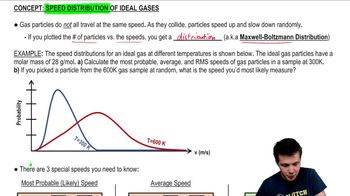
Speed Distribution & Special Speeds of Ideal Gases

Dimensional Analysis

Dimensional analysis is a method used in physics to convert units and check the consistency of equations. It involves examining the dimensions (such as length, time, mass) of physical quantities to derive the units of constants or variables. This technique is essential for determining the SI units of constants A and B in the given equation.
Recommended video:
Guided course
05:00
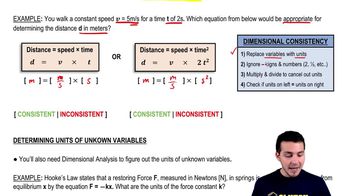
Dimensional Analysis

Constants in Equations of Motion

In equations of motion, constants like A and B represent specific coefficients that influence the behavior of the system. The units of these constants depend on the terms they are associated with in the equation. For example, if A is multiplied by time cubed (t³), its units must balance out to ensure the overall equation maintains consistent units for speed.
Recommended video:
Guided course
07:18
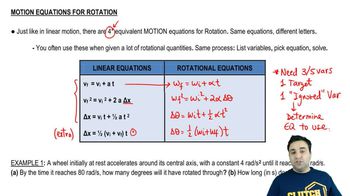
Equations of Rotational Motion
Related Practice
Textbook Question

American football uses a field that is 100.0 yd long, whereas a soccer field is 100.0 m long. Which field is longer, and by how much (give yards, meters, and percent)?

11
views

Textbook Question

A plumb bob (a mass m hanging on a string) is deflected from the vertical by an angle θ due to a massive mountain nearby (Fig. 6–37).

(b) Make a rough estimate of the mass of Mt. Everest, assuming it has the shape of a cone 4000 m high and base of diameter 4000 m. Assume its mass per unit volume is 3000kg per m³.

<IMAGE>

6
views
Textbook Question

One mole of atoms consists of 6.02 x 10²³ individual atoms. If a mole of atoms were spread uniformly over the Earth's surface, how many atoms would there be per square meter?

5
views
Textbook Question

Many sailboats are docked at a marina 4.4 km away on the opposite side of a lake. You stare at one of the sailboats because, when you are lying flat at the water's edge, you can just see its deck but none of the side of the sailboat. You then go to that sailboat on the other side of the lake and measure that the deck is 1.5 m above the level of the water. Using Fig. 1–14, where h = 1.5 m , estimate the radius R of the Earth.

4
views
Textbook Question

The following formula estimates an average person's lung capacity V (in liters, where 1 L = 10³ cm³): V = 4.1H ― 0.018A ―2.7, where H and A are the person's height (in meters) and age (in years), respectively. In this formula, what are the units of the numbers 4.1, 0.018, and 2.7?

3
views
Textbook Question

Show that the following combination of the three fundamental constants of nature that we used in Example 1–10 (that is G, c, and h) forms a quantity with the dimensions of time: tₚ = Gh\(\sqrt{Gh}\)/c⁵. This quantity, tₚ, is called the Planck time and is thought to be the earliest time, after the creation of the Universe, at which the currently known laws of physics can be applied.

507
views
5
rank