Ch 30: Electromagnetic Induction
Knight Calc - Physics for Scientists and Engineers 5th Edition
Knight Calc5th EditionPhysics for Scientists and EngineersISBN: 9780137344796Not the one you use?Change textbook
Chapter 30, Problem 5

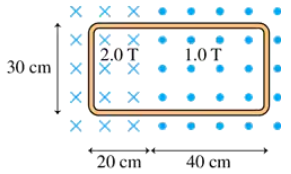
What is the magnitude of the magnetic flux through the loop shown in FIGURE EX30.5?

Verified step by step guidance
1
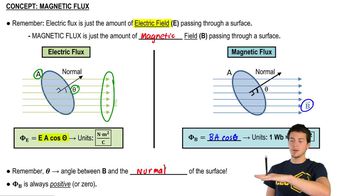
Step 1: Understand the concept of magnetic flux. Magnetic flux (Φ) is given by the formula Φ = B × A × cos(θ), where B is the magnetic field strength, A is the area through which the field passes, and θ is the angle between the magnetic field and the normal to the surface. In this case, the field is perpendicular to the loop, so cos(θ) = 1.
Step 2: Divide the loop into two regions based on the magnetic field strength. The left region has a magnetic field of 2.0 T, and the right region has a magnetic field of 1.0 T. Calculate the area of each region separately.
Step 3: Calculate the area of the left region. The width of the left region is 20 cm (0.20 m), and the height is 30 cm (0.30 m). Use the formula for area: A = width × height. For the left region, A_left = 0.20 m × 0.30 m.
Step 4: Calculate the area of the right region. The width of the right region is 40 cm (0.40 m), and the height is 30 cm (0.30 m). Use the formula for area: A = width × height. For the right region, A_right = 0.40 m × 0.30 m.
Step 5: Compute the magnetic flux for each region separately using Φ = B × A. For the left region, Φ_left = 2.0 T × A_left. For the right region, Φ_right = 1.0 T × A_right. Add the two fluxes together to find the total magnetic flux through the loop: Φ_total = Φ_left + Φ_right.

Verified video answer for a similar problem:

This video solution was recommended by our tutors as helpful for the problem above.
Was this helpful?

Key Concepts

Here are the essential concepts you must grasp in order to answer the question correctly.

Magnetic Flux

Magnetic flux is a measure of the quantity of magnetism, taking into account the strength and extent of a magnetic field. It is defined as the product of the magnetic field (B) and the area (A) through which the field lines pass, and is given by the formula Φ = B · A · cos(θ), where θ is the angle between the magnetic field lines and the normal to the surface. The unit of magnetic flux is the Weber (Wb).
Recommended video:
Guided course
04:52
Magnetic Flux

Magnetic Field Strength

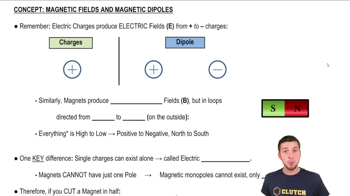
Magnetic field strength, denoted as B, is a vector quantity that represents the intensity of a magnetic field at a given point in space. It is measured in teslas (T) and indicates the force experienced by a unit magnetic pole placed in the field. In the context of the question, different regions of the magnetic field are indicated with varying strengths (1.0 T and 2.0 T), which will affect the total magnetic flux through the loop.
Recommended video:
Guided course
05:30
Magnetic Fields and Magnetic Dipoles

Area of the Loop

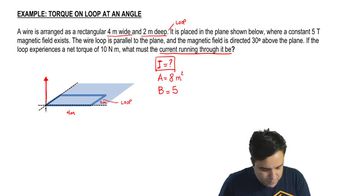
The area of the loop is crucial for calculating magnetic flux, as it determines how much of the magnetic field lines pass through the loop. The area (A) can be calculated using the formula A = length × width. In this case, the dimensions of the loop are given as 20 cm by 40 cm, which must be converted to meters for consistency in SI units when calculating the magnetic flux.
Recommended video:
Guided course
05:03
Torque on a Loop at an Angle
Related Practice
Textbook Question

An equilateral triangle 8.0 cm on a side is in a 5.0 mT uniform magnetic field. The magnetic flux through the triangle is 6.0 μWb. What is the angle between the magnetic field and an axis perpendicular to the plane of the triangle?

Textbook Question

FIGURE EX30.8 shows a 2.0-cm-diameter solenoid passing through the center of a 6.0-cm-diameter loop. The magnetic field inside the solenoid is 0.20 T. What is the magnitude of the magnetic flux through the loop when it is perpendicular to the solenoid and when it is tilted at a 60° angle?

2
views
Textbook Question

A solenoid is wound as shown in FIGURE EX30.9. Is there an induced current as magnet 2 is moved away from the solenoid? If so, what is the current direction through resistor R?

1
views
Textbook Question

A potential difference of 0.050 V is developed across the 10-cm-long wire of FIGURE EX30.3 as it moves through a magnetic field perpendicular to the figure. What are the strength and direction (in or out) of the magnetic field?

1
views
Textbook Question

INT A 10-cm-long wire is pulled along a U-shaped conducting rail in a perpendicular magnetic field. The total resistance of the wire and rail is 0.20 Ω. Pulling the wire at a steady speed of 4.0 m/s causes 4.0 W of power to be dissipated in the circuit. How big is the pulling force?

3
views
Textbook Question

The earth’s magnetic field strength is 5.0×10⁻⁵ T. How fast would you have to drive your car to create a 1.0 V motional emf along your 1.0-m-tall radio antenna? Assume that the motion of the antenna is perpendicular to B\(\overrightarrow{B}\).

1
views