Ch 29: The Magnetic Field
Knight Calc - Physics for Scientists and Engineers 5th Edition
Knight Calc5th EditionPhysics for Scientists and EngineersISBN: 9780137344796Not the one you use?Change textbook
Chapter 29, Problem 6

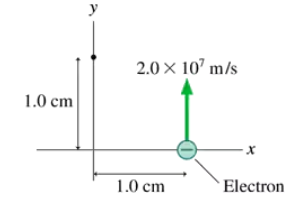
What is the magnetic field at the position of the dot in FIGURE EX29.6? Give your answer as a vector.

Verified step by step guidance
1
Step 1: Identify the configuration of the current-carrying wires in FIGURE EX29.6. Determine the direction of the current in each wire and their relative positions to the dot where the magnetic field is to be calculated.
Step 2: Use the Biot-Savart Law or Ampere's Law to calculate the magnetic field contribution from each wire at the position of the dot. The Biot-Savart Law states: B=μ0I2πr, where μ0 is the permeability of free space, I is the current, and r is the distance from the wire to the point of interest.
Step 3: Determine the direction of the magnetic field produced by each wire using the right-hand rule. For a straight current-carrying wire, point your thumb in the direction of the current, and your curled fingers will indicate the direction of the magnetic field around the wire.
Step 4: Add the magnetic field vectors from each wire at the position of the dot. Since magnetic fields are vector quantities, consider both the magnitude and direction of each field contribution. Use vector addition to combine the fields.
Step 5: Express the resultant magnetic field at the dot as a vector in terms of its components (e.g., (Bx,By,Bz)). Ensure the direction and magnitude are consistent with the vector addition performed in the previous step.

Verified video answer for a similar problem:

This video solution was recommended by our tutors as helpful for the problem above.
Video duration:
6m
Was this helpful?

Key Concepts

Here are the essential concepts you must grasp in order to answer the question correctly.

Magnetic Field

The magnetic field is a vector field that describes the magnetic influence on moving electric charges, electric currents, and magnetic materials. It is represented by the symbol B and is measured in teslas (T). The direction of the magnetic field is defined as the direction a north pole of a magnet would move, and its strength can vary depending on the source and distance from it.
Recommended video:
Guided course
05:30
Magnetic Fields and Magnetic Dipoles

Vector Representation

A vector is a quantity that has both magnitude and direction. In the context of magnetic fields, representing the magnetic field as a vector means specifying both its strength and the direction in which it acts. This is crucial for understanding how the magnetic field interacts with charged particles and other magnetic fields, as the effects depend on both the magnitude and orientation of the vectors involved.
Recommended video:
Guided course
06:44
Adding 3 Vectors in Unit Vector Notation

Biot-Savart Law

The Biot-Savart Law is a fundamental principle used to calculate the magnetic field generated by a current-carrying conductor. It states that the magnetic field dB at a point in space is proportional to the current I, the length element of the conductor, and the sine of the angle between the current element and the line connecting the element to the point, divided by the square of the distance from the element to the point. This law is essential for determining the magnetic field at specific locations in complex configurations.
Recommended video:
Guided course
04:53
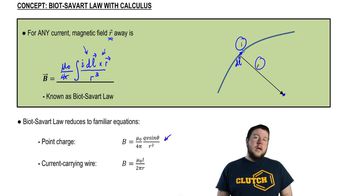
Biot-Savart Law with Calculus