
Ch. 30 - Inductance, Electromagnetic Oscillations, and AC Circuits
Giancoli Douglas - Physics for Scientists and Engineers 5th edition
Giancoli Douglas5th editionPhysics for Scientists and EngineersISBN: 9780137488179Not the one you use?Change textbook
Chapter 29, Problem 62a

(II) (a) Show that oscillation of charge Q on the capacitor of an LRC circuit has amplitude


Q0=V0(ωR)2+(ω2L1C)2.Q_0 = \(\frac{V_0}{\sqrt{(\omega R)^2 + \left(\omega^2 L - \frac{1}{C}\]\right\))^2}}.

Verified step by step guidance
1
Understand the problem: The goal is to derive the amplitude of the oscillation of charge Q on the capacitor in an LRC circuit. This involves analyzing the circuit's behavior using the principles of oscillatory motion and electrical resonance.
Start with the differential equation for an LRC circuit: The charge Q on the capacitor satisfies the second-order differential equation: Ld2Qdt2 + RdQdt + QC = 0, where L is the inductance, R is the resistance, and C is the capacitance.
Solve the differential equation: Assume a solution of the form Q(t) = Qmaxe(-R2L)cos(ωt), where ω is the angular frequency of oscillation. Substitute this into the differential equation to confirm the solution.
Determine the angular frequency: The angular frequency ω is given by ω = 1LC - R24LL2. This accounts for the damping effect of the resistor.
Relate the amplitude to initial conditions: The amplitude of the charge oscillation, Qmax, depends on the initial charge on the capacitor and the energy stored in the circuit. Use the conservation of energy principle to express Qmax in terms of the circuit parameters.

Verified video answer for a similar problem:

This video solution was recommended by our tutors as helpful for the problem above.
Video duration:
3m
Was this helpful?

Key Concepts

Here are the essential concepts you must grasp in order to answer the question correctly.

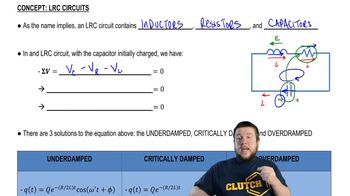
LRC Circuit

An LRC circuit consists of an inductor (L), a resistor (R), and a capacitor (C) connected in series or parallel. This circuit exhibits oscillatory behavior due to the energy exchange between the inductor's magnetic field and the capacitor's electric field. The oscillation frequency is determined by the values of L and C, and the damping effect of R influences the amplitude and duration of the oscillations.
Recommended video:

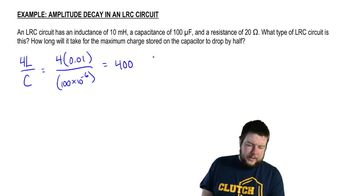
Amplitude of Oscillation

The amplitude of oscillation in an LRC circuit refers to the maximum displacement of charge or current from its equilibrium position during oscillation. It is influenced by the initial conditions of the circuit, such as the initial charge on the capacitor and the energy stored in the inductor. The amplitude can decrease over time due to resistive losses, leading to damped oscillations.
Recommended video:
Guided course
04:24
Amplitude Decay in an LRC Circuit

Damped Oscillations

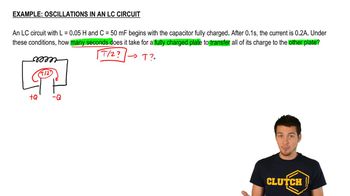
Damped oscillations occur when the amplitude of oscillation decreases over time due to energy loss, typically from resistance in the circuit. In an LRC circuit, the damping factor is determined by the resistance value, which affects how quickly the oscillations diminish. Understanding damped oscillations is crucial for analyzing the behavior of the circuit over time and predicting the eventual stabilization of the charge.
Recommended video:
Guided course
04:26
Oscillations in an LC Circuit
Related Practice
Textbook Question

The frequency of the ac voltage source (peak voltage Vo) in an LRC circuit is tuned to the circuit’s resonant frequency f₀ = 1 / (2π√LC). (a) Show that the peak voltage across the capacitor is Vco = VoTo/ (2πτ), where To ( =1/fo) is the period of the resonant frequency and τ = RC is the time constant for charging the capacitor C through a resistor R. (b) Define β = To/ (2πτ) so that Vco = βVo. Then β is the “amplification” of the source voltage across the capacitor. If a particular LRC circuit contains a 2.0-nF capacitor and has a resonant frequency of 5.0 kHz, what value of R will yield β = 125?

2
views
Textbook Question

At t = 0, the current through a 60.0-mH inductor is 50.0 mA and is increasing at the rate of 78.0 mA/s. What is the initial energy stored in the inductor, and how long does it take for the energy to increase by a factor of 8.0 from the initial value?

2
views
Textbook Question

An ac voltage source is connected in series with a 2.0-μF capacitor and a 750-Ω resistor. Using a digital ac voltmeter, the voltage source is measured to be 4.0 V rms, and the voltages across the resistor and across the capacitor are found to be 3.0 V rms and 2.7 V rms, respectively. Determine the frequency of the ac voltage source. Why is the voltage measured across the voltage source not equal to the sum of the voltages measured across the resistor and across the capacitor?

2
views
Textbook Question

The output of an electrocardiogram amplifier has an impedance of 45 Ω. It is to be connected to an 8.0-Ω loudspeaker through a transformer. What should be the turns ratio of the transformer?

Textbook Question

An average power output of 150 W is sent into a 4-Ω loudspeaker (see Fig. 25–14). What are the rms voltage and the rms current fed to the speaker at 1.0 W when the volume is turned down?

1
views
Textbook Question

Show that the power delivered by a three-phase ac source equals a constant P = 3Vo²/2R, by combining the four equations in Section 30–11.

2
views