
Ch 11: Impulse and Momentum
Knight Calc - Physics for Scientists and Engineers 5th Edition
Knight Calc5th EditionPhysics for Scientists and EngineersISBN: 9780137344796Not the one you use?Change textbook
Chapter 11, Problem 20

A 30 g dart traveling horizontally hits and sticks in the back of a 500 g toy car, causing the car to roll forward at 1.4 m/s. What was the speed of the dart?

Verified step by step guidance
1
Identify the principle to use: This is a conservation of momentum problem. The total momentum before the collision equals the total momentum after the collision, as no external forces act on the system.
Write the equation for conservation of momentum: m1v1 + m2v2 = (m1 + m2)vf, where m1 and v1 are the mass and velocity of the dart, m2 and v2 are the mass and velocity of the toy car before the collision, and vf is the final velocity of the combined system.
Substitute the known values into the equation: The mass of the dart is 0.03 kg, the mass of the toy car is 0.5 kg, the initial velocity of the toy car is 0 m/s (since it is stationary), and the final velocity of the combined system is 1.4 m/s. The equation becomes: 0.03v1 + 0.5(0) = (0.03 + 0.5)(1.4).
Simplify the equation: The term 0.5(0) becomes 0, so the equation reduces to 0.03v1 = (0.53)(1.4). Solve for v1 by dividing both sides by 0.03.
Perform the final calculation: After isolating v1, compute the value of (0.53)(1.4)/0.03 to find the initial speed of the dart.

Verified video answer for a similar problem:

This video solution was recommended by our tutors as helpful for the problem above.
Video duration:
5m
Was this helpful?

Key Concepts

Here are the essential concepts you must grasp in order to answer the question correctly.

Conservation of Momentum

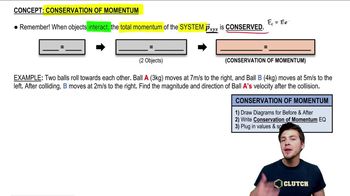
The principle of conservation of momentum states that in a closed system, the total momentum before an event must equal the total momentum after the event. In this scenario, the dart and the toy car form a closed system where the dart collides with the car. The momentum of the dart before the collision must equal the combined momentum of the dart and car after they stick together.
Recommended video:
Guided course
05:58
Conservation Of Momentum

Momentum Calculation

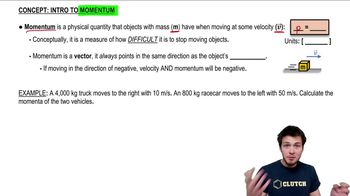
Momentum is calculated as the product of an object's mass and its velocity (p = mv). For the dart and the toy car, we need to calculate their individual momenta before and after the collision. The dart's momentum before the collision can be expressed as the product of its mass and its unknown velocity, while the car's momentum after the collision is the product of its combined mass and the final velocity.
Recommended video:
Guided course
05:17
Intro to Momentum

Inelastic Collision

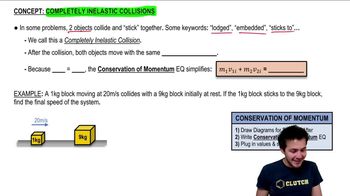
An inelastic collision is a type of collision where the colliding objects stick together after the impact, resulting in a loss of kinetic energy. In this case, the dart embeds itself in the toy car, making it an inelastic collision. While momentum is conserved, kinetic energy is not, which is important to consider when analyzing the system's behavior post-collision.
Recommended video:
Guided course
04:18
Completely Inelastic Collisions
Related Practice
Textbook Question

Three identical train cars, coupled together, are rolling east at speed v0. A fourth car traveling east at 2v0 catches up with the three and couples to make a four-car train. A moment later, the train cars hit a fifth car that was at rest on the tracks, and it couples to make a five-car train. What is the speed of the five-car train?

4
views
Textbook Question

A 1500 kg car is rolling at 2.0 m/s. You would like to stop the car by firing a 10 kg blob of sticky clay at it. How fast should you fire the clay?

1
views
Textbook Question

Fred (mass 60 kg) is running with the football at a speed of 6.0 m/s when he is met head-on by Brutus (mass 120 kg), who is moving at 4.0 m/s. Brutus grabs Fred in a tight grip, and they fall to the ground. Which way do they slide, and how far? The coefficient of kinetic friction between football uniforms and Astroturf is 0.30.

Textbook Question

A 300 g bird flying along at 6.0 m/s sees a 10 g insect heading straight toward it at a speed of 30 m/s. The bird opens its mouth wide and enjoys a nice lunch. What is the bird’s speed immediately after swallowing?

2
views
Textbook Question

A proton is traveling to the right at 2.0 x 10⁷ m/s. It has a head-on perfectly elastic collision with a carbon atom. The mass of the carbon atom is 12 times the mass of the proton. What are the speed and direction of each after the collision?

1
views
Textbook Question

A 50 g marble moving at 2.0 m/s strikes a 20 g marble at rest. What is the speed of each marble immediately after the collision?

1
views