The cannon in FIGURE CP4.83 fires a projectile at launch angle θ with respect to the slope, which is at angle Φ. Find the launch angle that maximizes d. Hint: Choosing the proper coordinate system is essential. There are two options.
Ch 04: Kinematics in Two Dimensions
Knight Calc5th EditionPhysics for Scientists and EngineersISBN: 9780137344796Not the one you use?Change textbook
Chapter 4, Problem 84
A cannon on a flat railroad car travels to the east with its barrel tilted 30° above horizontal. It fires a cannonball at 50 m/s. At t = 0 s , the car, starting from rest, begins to accelerate to the east at 2.0 m/s². At what time should the cannon be fired to hit a target on the tracks that is 400 m to the east of the car's initial position? Assume that the cannonball is fired from ground level.
Verified step by step guidance1
Step 1: Break the problem into two components: horizontal motion and vertical motion. The horizontal motion involves the cannonball's velocity and the car's acceleration, while the vertical motion involves the cannonball's trajectory due to gravity.
Step 2: Resolve the initial velocity of the cannonball into horizontal and vertical components using trigonometry. The horizontal velocity is given by \( v_x = v \cdot \cos(\theta) \), and the vertical velocity is given by \( v_y = v \cdot \sin(\theta) \), where \( v = 50 \, \text{m/s} \) and \( \theta = 30^\circ \).
Step 3: Write the equations of motion for the cannonball. For horizontal motion, the position \( x \) is given by \( x = v_x \cdot t + \frac{1}{2} a \cdot t^2 \), where \( a = 2.0 \, \text{m/s}^2 \) is the car's acceleration. For vertical motion, the position \( y \) is given by \( y = v_y \cdot t - \frac{1}{2} g \cdot t^2 \), where \( g = 9.8 \, \text{m/s}^2 \) is the acceleration due to gravity.
Step 4: Determine the condition for hitting the target. The cannonball must reach \( x = 400 \, \text{m} \) horizontally while remaining at \( y = 0 \, \text{m} \) vertically (since the target is on the ground). Solve the horizontal motion equation \( 400 = v_x \cdot t + \frac{1}{2} a \cdot t^2 \) for \( t \).
Step 5: Verify the solution by ensuring that the vertical motion equation \( y = v_y \cdot t - \frac{1}{2} g \cdot t^2 \) equals zero at the same time \( t \). This ensures the cannonball lands on the ground at the target's position. Combine both equations to find the correct firing time.

Verified video answer for a similar problem:
This video solution was recommended by our tutors as helpful for the problem above.
Was this helpful?
Key Concepts
Here are the essential concepts you must grasp in order to answer the question correctly.
Projectile Motion
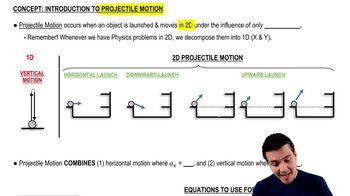
Projectile motion refers to the motion of an object that is launched into the air and is subject to gravitational forces. It can be analyzed in two dimensions: horizontal and vertical. The horizontal motion is uniform, while the vertical motion is influenced by gravity, leading to a parabolic trajectory. Understanding the equations of motion for both dimensions is crucial for predicting the projectile's path and impact point.
Recommended video:
Guided course
Introduction to Projectile Motion
Relative Motion
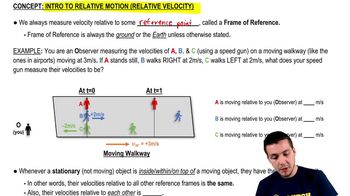
Relative motion involves analyzing the movement of an object in relation to another object. In this scenario, the cannonball's motion must be considered relative to both the moving railroad car and the stationary target. This requires understanding how the acceleration of the car affects the timing of the cannonball's launch to ensure it intersects with the target's position as both move over time.
Recommended video:
Guided course
Intro to Relative Motion (Relative Velocity)
Kinematic Equations
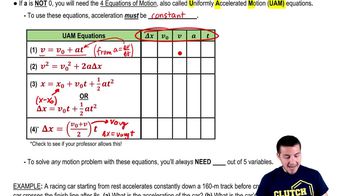
Kinematic equations describe the relationships between an object's displacement, velocity, acceleration, and time. These equations are essential for solving problems involving motion, particularly when acceleration is constant. In this problem, they will be used to calculate the time it takes for both the cannonball and the railroad car to reach the target's position, allowing for the determination of the optimal firing time.
Recommended video:
Guided course
Kinematics Equations
Related Practice
Textbook Question
2
views
Textbook Question
In Problems 78, 79, and 80 you are given the equations that are used to solve a problem. For each of these, you are to write a realistic problem for which these are the correct equations. Be sure that the answer your problem requests is consistent with the equations given.
3
views
Textbook Question
An archer standing on a 15° slope shoots an arrow 20° above the horizontal, as shown in FIGURE CP4.82. How far down the slope does the arrow hit if it is shot with a speed of 5.0 m/s from 1.75 m above the ground?
2
views