Ch 04: Kinematics in Two Dimensions
Knight Calc - Physics for Scientists and Engineers 5th Edition
Knight Calc5th EditionPhysics for Scientists and EngineersISBN: 9780137344796Not the one you use?Change textbook
Chapter 4, Problem 82

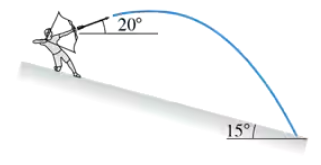
An archer standing on a 15° slope shoots an arrow 20° above the horizontal, as shown in FIGURE CP4.82. How far down the slope does the arrow hit if it is shot with a speed of 5.0 m/s from 1.75 m above the ground?

Verified step by step guidance
1
Step 1: Break the initial velocity into components. The arrow is shot at an angle of 20° above the horizontal with a speed of 5.0 m/s. Use trigonometric functions to find the horizontal and vertical components of the velocity: \( v_x = v \cdot \cos(20°) \) and \( v_y = v \cdot \sin(20°) \).
Step 2: Set up the equations of motion. The motion of the arrow can be described using the kinematic equations. For the vertical motion, use \( y = y_0 + v_y \cdot t - \frac{1}{2} g \cdot t^2 \), where \( y_0 = 1.75 \, \text{m} \) is the initial height, \( g = 9.8 \, \text{m/s}^2 \) is the acceleration due to gravity, and \( t \) is the time. For the horizontal motion, use \( x = v_x \cdot t \).
Step 3: Account for the slope. The slope is inclined at 15° below the horizontal. The equation of the slope can be expressed as \( y = -x \cdot \tan(15°) \). Combine this with the equations of motion to find the point where the arrow intersects the slope.
Step 4: Solve for the time of flight. Substitute \( y = -x \cdot \tan(15°) \) into the vertical motion equation and use the horizontal motion equation to express \( x \) in terms of \( t \). Solve the resulting equation for \( t \).
Step 5: Calculate the distance down the slope. Once \( t \) is determined, use the horizontal motion equation to find \( x \), and then use the slope equation \( y = -x \cdot \tan(15°) \) to find the corresponding \( y \). The distance down the slope can be calculated using the Pythagorean theorem: \( d = \sqrt{x^2 + y^2} \).

Key Concepts

Here are the essential concepts you must grasp in order to answer the question correctly.

Projectile Motion

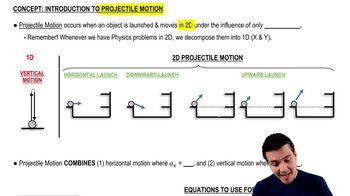
Projectile motion refers to the motion of an object that is launched into the air and is subject to the force of gravity. It can be analyzed in two dimensions: horizontal and vertical. The horizontal motion is uniform, while the vertical motion is influenced by gravitational acceleration. Understanding the trajectory of the arrow involves calculating its horizontal and vertical displacements over time.
Recommended video:
Guided course
04:44
Introduction to Projectile Motion

Inclined Plane

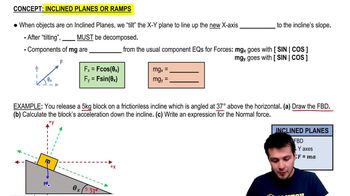
An inclined plane is a flat surface that is tilted at an angle to the horizontal. In this scenario, the slope of 15° affects the arrow's landing position. The angle of the slope must be considered when calculating the distance the arrow travels down the slope, as it alters the effective gravitational force acting on the projectile and influences its trajectory.
Recommended video:
Guided course
06:59
Intro to Inclined Planes

Initial Velocity Components

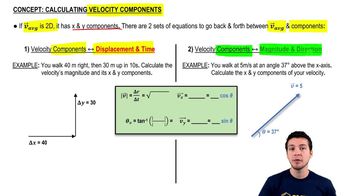
The initial velocity of the arrow can be broken down into its horizontal and vertical components using trigonometric functions. Given the launch angle of 20° above the horizontal, the horizontal component is found using cosine, while the vertical component is found using sine. These components are crucial for determining the time of flight and the distance traveled in both the horizontal and vertical directions.
Recommended video:
Guided course
05:53
Calculating Velocity Components
Related Practice
Textbook Question

The cannon in FIGURE CP4.83 fires a projectile at launch angle θ with respect to the slope, which is at angle Φ. Find the launch angle that maximizes d. Hint: Choosing the proper coordinate system is essential. There are two options.

2
views
Textbook Question

A cannon on a flat railroad car travels to the east with its barrel tilted 30° above horizontal. It fires a cannonball at 50 m/s. At t = 0 s , the car, starting from rest, begins to accelerate to the east at 2.0 m/s². At what time should the cannon be fired to hit a target on the tracks that is 400 m to the east of the car's initial position? Assume that the cannonball is fired from ground level.

2
views
Textbook Question

In Problems 78, 79, and 80 you are given the equations that are used to solve a problem. For each of these, you are to write a realistic problem for which these are the correct equations. Be sure that the answer your problem requests is consistent with the equations given.

100m=0m+(50cosθm/s)t10m=0m+(50sinθm/s)t112(9.80m/s2)t12\(\begin{aligned}\)100 \, \(\text{m}\) &= 0 \, \(\text{m}\) + (50 \(\cos\) \(\theta\) \, \(\text{m/s}\)) t_1 \\0 \, \(\text{m}\) &= 0 \, \(\text{m}\) + (50 \(\sin\) \(\theta\) \, \(\text{m/s}\)) t_1 - \(\frac{1}{2}\) (9.80 \, \(\text{m/s}\)^2) t_1^2\(\end{aligned}\)

3
views
Textbook Question

A 6.0-cm-diameter gear rotates with angular velocity ω = ( 20 ─ ½ t² ) rad/s where t is in seconds. At t = 4.0 s, what are: The tangential acceleration of a tooth on the gear?

2
views
Textbook Question

A painted tooth on a spinning gear has angular position θ = (6.0 rad/s⁴)t⁴. What is the tooth's angular acceleration at the end of 10 revolutions?

1
views