
Ch 24: Gauss' Law
Knight Calc - Physics for Scientists and Engineers 5th Edition
Knight Calc5th EditionPhysics for Scientists and EngineersISBN: 9780137344796Not the one you use?Change textbook
Chapter 24, Problem 7

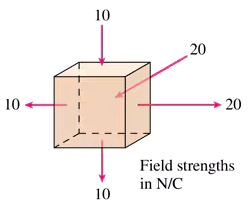
The cube in FIGURE EX24.7 contains negative charge. The electric field is constant over each face of the cube. Does the missing electric field vector on the front face point in or out? What strength must this field exceed?
Cube with electric field vectors showing strengths of 10 N/C on three faces and 20 N/C on two faces.

Verified step by step guidance
1
Step 1: Begin by recalling Gauss's law, which states that the net electric flux through a closed surface is proportional to the net charge enclosed within the surface. Mathematically, Gauss's law is expressed as: EdA=q/ε0, where E is the electric field, dA is the area element, q is the enclosed charge, and ε0 is the permittivity of free space.
Step 2: Analyze the given diagram. The cube has electric field vectors pointing outward on five faces, with magnitudes of 10 N/C and 20 N/C. The missing vector on the front face must balance the net flux to account for the negative charge inside the cube.
Step 3: Calculate the net flux through the cube. The flux through each face is given by Φ=EA, where A is the area of the face. Assume the area of each face is constant. Sum the flux contributions from all faces, including the missing front face.
Step 4: Since the charge inside the cube is negative, the net flux must be inward. This means the missing electric field vector on the front face must point inward to balance the outward flux from the other faces.
Step 5: To determine the strength of the missing field, ensure that the inward flux exceeds the total outward flux from the other faces. Use the relationship Φ=q/ε0 to calculate the required field strength, ensuring it accounts for the negative charge enclosed.

Verified video answer for a similar problem:

This video solution was recommended by our tutors as helpful for the problem above.
Was this helpful?

Key Concepts

Here are the essential concepts you must grasp in order to answer the question correctly.

Electric Field

An electric field is a region around a charged object where other charged objects experience a force. It is represented by vectors indicating the direction and strength of the force per unit charge. The strength of the electric field (measured in N/C) is determined by the amount of charge and the distance from the charge. In this scenario, the electric field vectors on the cube's faces indicate how the field interacts with the negative charge inside.
Recommended video:
Guided course
03:16
Intro to Electric Fields

Gauss's Law

Gauss's Law relates the electric flux through a closed surface to the charge enclosed by that surface. It states that the total electric flux is proportional to the enclosed charge, allowing us to determine the electric field in symmetrical situations. In this case, understanding Gauss's Law helps in analyzing the electric field distribution around the cube and determining the direction of the missing electric field vector.
Recommended video:

Direction of Electric Field Vectors

The direction of electric field vectors is defined as the direction a positive test charge would move in the presence of the electric field. For negative charges, the electric field vectors point towards the charge. In the context of the cube, the missing electric field vector on the front face must point inward, towards the negative charge, to maintain equilibrium with the other field vectors acting on the cube.
Recommended video:
Guided course
03:16
Intro to Electric Fields
Related Practice
Textbook Question

FIGURE EX24.2 shows a cross section of two concentric spheres. The inner sphere has a negative charge. The outer sphere has a positive charge larger in magnitude than the charge on the inner sphere. Draw this figure on your paper, then draw electric field vectors showing the shape of the electric field.

1
views
Textbook Question

The electric field is constant over each face of the tetrahedron shown in FIGURE EX24.4. Does the box contain positive charge, negative charge, or no charge? Explain.

2
views
Textbook Question

The electric flux through the surface shown in FIGURE EX24.10 is 25 N m²/C. What is the electric field strength?

1
views
Textbook Question

A 2.0 cm × 3.0 cm rectangle lies in the xzxz-plane with unit vector n^\(\hat{n}\) pointing in the +y-direction. What is the electric flux through the rectangle if the electric field is E=(4000i^2000k^)\(\overrightarrow{E}\)=(4000\(\hat{i}\)-2000\(\hat{k}\)) N/C?

1
views
Textbook Question

A 12 cm × 12 cm rectangle lies in the first quadrant of the xy-plane with one corner at the origin. Unit vector n^\(\hat{n}\) points in the +𝒵-direction. What is the electric flux through the rectangle if the electric field is E=(2000m1)xk^E=(2000m^{-1})x\(\hat{k}\) N/C? Hint: Divide the rectangle into narrow strips of width.

1
views
Textbook Question

FIGURE EX24.3 shows a cross section of two infinite parallel planes of charge. Draw this figure on your paper, then draw electric field vectors showing the shape of the electric field.

1
views