
Ch. 09 - Linear Momentum
Giancoli Douglas - Physics for Scientists and Engineers 5th edition
Giancoli Douglas5th editionPhysics for Scientists and EngineersISBN: 9780137488179Not the one you use?Change textbook
Chapter 9, Problem 24b

The force on a bullet along the barrel of a firearm is given by the formula F = [740 ― (2.3 x 10⁵ s⁻¹ ) t] N over the time interval t = 0 to t = 3.0 x 10⁻³ s. Plot a graph of F versus t for t = 0 to t = 3.0 ms. Use the graph to estimate the impulse given the bullet.

Verified step by step guidance
1
Step 1: Understand the problem. The force on the bullet is given as a function of time: F(t) = 740 - (2.3 × 10⁵ s⁻¹) t. The task is to plot F versus t for the time interval t = 0 to t = 3.0 × 10⁻³ s and then estimate the impulse using the graph.
Step 2: Create a table of values for F(t) at different time points within the interval t = 0 to t = 3.0 × 10⁻³ s. Choose several time points (e.g., t = 0, t = 1.0 × 10⁻³ s, t = 2.0 × 10⁻³ s, t = 3.0 × 10⁻³ s) and calculate F(t) for each using the formula F(t) = 740 - (2.3 × 10⁵ s⁻¹) t.
Step 3: Plot the graph of F versus t. Use the calculated values of F(t) from Step 2 to create a graph. The x-axis represents time (t) in seconds, and the y-axis represents force (F) in newtons. Connect the points to form a straight line, as the equation is linear in t.
Step 4: Estimate the impulse from the graph. Impulse is the area under the F versus t curve. Since the graph is a straight line, the area under the curve forms a trapezoid. Use the formula for the area of a trapezoid: A = 0.5 × (base1 + base2) × height, where base1 and base2 are the force values at t = 0 and t = 3.0 × 10⁻³ s, and height is the time interval (3.0 × 10⁻³ s).
Step 5: Verify the units of impulse. Impulse is the product of force and time, so its unit is N·s (newton-seconds). Ensure that the calculated area under the curve has consistent units to represent impulse correctly.

Verified video answer for a similar problem:

This video solution was recommended by our tutors as helpful for the problem above.
Video duration:
8m
Was this helpful?

Key Concepts

Here are the essential concepts you must grasp in order to answer the question correctly.

Force and Time Relationship

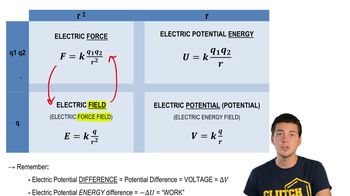
The force acting on an object can vary over time, as described by the equation F = [740 - (2.3 x 10⁵ s⁻¹) t]. This formula indicates that the force decreases linearly as time increases, which is crucial for understanding how the bullet is accelerated within the barrel of the firearm. Analyzing this relationship helps in visualizing how the force changes and affects the bullet's motion.
Recommended video:
Guided course
03:43
Relationships Between Force, Field, Energy, Potential

Impulse

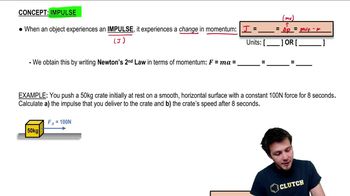
Impulse is defined as the change in momentum of an object when a force is applied over a period of time. It can be calculated as the area under the force versus time graph. In this context, estimating the impulse given to the bullet involves integrating the force over the specified time interval, which provides insight into the bullet's final velocity and momentum.
Recommended video:
Guided course
06:00
Impulse & Impulse-Momentum Theorem

Graphing Techniques

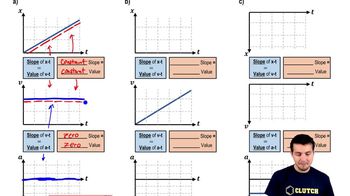
Graphing techniques are essential for visualizing mathematical relationships, such as the force versus time graph in this problem. By plotting the force values against time, one can easily identify trends, calculate areas, and derive important physical quantities like impulse. Understanding how to accurately represent and interpret graphs is vital for solving problems in physics.
Recommended video:
Guided course
07:32
Graphing Position, Velocity, and Acceleration Graphs
Related Practice
Textbook Question

A 144-g baseball moving 28.0 m/s strikes a stationary 4.85-kg brick resting on small rollers so it moves without significant friction. After hitting the brick, the baseball bounces straight back, and the brick moves forward at 1.10 m/s. What is the baseball’s speed after the collision?

1
views
Textbook Question

A 195-kg projectile, fired with a speed of 116 m/s at a 60.0° angle, breaks into three pieces of equal mass at the highest point of its arc (where its velocity is horizontal). Two of the fragments move with the same speed right after the explosion as the entire projectile had just before the explosion; one of these moves vertically downward and the other horizontally. Determine the velocity of the third fragment immediately after the explosion.

2
views
Textbook Question

A 144-g baseball moving 28.0 m/s strikes a stationary 4.85-kg brick resting on small rollers so it moves without significant friction. After hitting the brick, the baseball bounces straight back, and the brick moves forward at 1.10 m/s. Find the total kinetic energy before and after the collision.

1
views
Textbook Question

The force on a bullet along the barrel of a firearm is given by the formula F = [740 ― (2.3 x 10⁵ s⁻¹ ) t] N over the time interval t = 0 to t = 3.0 x 10⁻³ s. Plot a graph of F versus t for t = 0 to t = 3.0 ms.

2
views
Textbook Question

A mass mₐ = 2.0 kg, moving with velocity va\(\overrightarrow{v_{a}\)} = (4.0 î + 5.0 ĵ ― 2.0 k̂) m/s, collides with mass m₈ = 3.0 kg, which is initially at rest. Immediately after the collision, mass mₐ is observed traveling at velocity va\(\overrightarrow{v_{a}\)^{\(\prime\)}} = (― 2.0 î + 3.0 k̂) m/s. Find the velocity of mass m₈ after the collision. Assume no outside force acts on the two masses during the collision.

1
views
Textbook Question

Croquet ball A moving at 4.3 m/s makes a head-on collision with ball B of equal mass initially at rest. Immediately after the collision, ball B moves forward at 3.0 m/s. What fraction of the initial kinetic energy is lost in the collision?

1
views