Ch 07: Potential Energy & Conservation
Young & Freedman Calc - University Physics 14th Edition
Young & Freedman Calc14th EditionUniversity PhysicsISBN: 9780321973610Not the one you use?Change textbook
Chapter 7, Problem 18ab

A slingshot will shoot a 1010-g pebble 22.022.0 m straight up. With the same potential energy stored in the rubber band, how high can the slingshot shoot a 2525-g pebble? What physical effects did you ignore in solving this problem?

Verified step by step guidance
1
Step 1: Begin by understanding the conservation of energy principle. The potential energy stored in the slingshot's rubber band is converted into the kinetic energy of the pebble, which is then converted into gravitational potential energy at the pebble's maximum height. The formula for gravitational potential energy is \( U = m g h \), where \( m \) is the mass, \( g \) is the acceleration due to gravity, and \( h \) is the height.
Step 2: For the first pebble (10 g), calculate the potential energy stored in the slingshot using \( U = m g h \). Substitute \( m = 0.010 \, \text{kg} \), \( g = 9.8 \, \text{m/s}^2 \), and \( h = 22.0 \, \text{m} \). This gives the total energy stored in the slingshot.
Step 3: For the second pebble (25 g), the same amount of potential energy is stored in the slingshot. Use the formula \( U = m g h \) again, but this time substitute \( m = 0.025 \, \text{kg} \) and solve for \( h \). Rearrange the formula to \( h = \frac{U}{m g} \).
Step 4: Compare the heights for the two pebbles. Notice that the height is inversely proportional to the mass of the pebble, meaning the heavier pebble will reach a lower height given the same stored energy.
Step 5: For part (c), discuss the physical effects ignored in this problem. These include air resistance, which would reduce the height reached by the pebble, and any energy losses in the slingshot mechanism, such as friction or deformation of the rubber band. These factors are not accounted for in the idealized calculation.

Verified video answer for a similar problem:

This video solution was recommended by our tutors as helpful for the problem above.
Video duration:
6m
Was this helpful?

Key Concepts

Here are the essential concepts you must grasp in order to answer the question correctly.

Potential Energy

Potential energy is the energy stored in an object due to its position in a gravitational field. It is calculated using the formula PE = mgh, where m is mass, g is the acceleration due to gravity, and h is the height. In this context, the potential energy stored in the slingshot's rubber band is converted into gravitational potential energy when the pebble is launched.
Recommended video:
Guided course
07:24
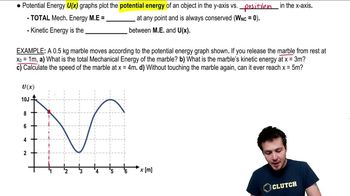
Potential Energy Graphs

Conservation of Energy

The principle of conservation of energy states that energy cannot be created or destroyed, only transformed from one form to another. In this problem, the potential energy stored in the slingshot is converted into kinetic energy as the pebble is launched, and then into gravitational potential energy as it rises. This principle allows us to relate the heights reached by different masses when the same initial energy is applied.
Recommended video:
Guided course
06:24
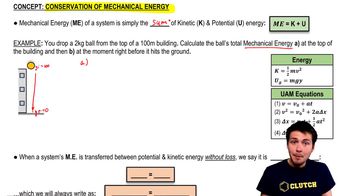
Conservation Of Mechanical Energy

Mass and Acceleration

Mass affects how much gravitational potential energy an object has and how it accelerates under the influence of gravity. In this scenario, the different masses of the pebbles (10 g and 25 g) will influence the height they can reach when launched with the same initial energy. The relationship between mass and acceleration is crucial for understanding how energy is distributed and converted in the system.
Recommended video:
Guided course
03:42
Torque & Acceleration of a Point Mass
Related Practice
Textbook Question

A slingshot will shoot a 1010-g pebble 22.022.0 m straight up. How much potential energy is stored in the slingshot's rubber band?

2
views

Textbook Question

A spring of negligible mass has force constant k=1600k = 1600 N/m. How far must the spring be compressed for 3.203.20 J of potential energy to be stored in it?

2
views
Textbook Question

A spring of negligible mass has force constant k=1600k = 1600 N/m. You place the spring vertically with one end on the floor. You then drop a 1.201.20-kg book onto it from a height of 0.8000.800 m above the top of the spring. Find the maximum distance the spring will be compressed.

2
views
Textbook Question

A spring of negligible mass has force constant k=800k = 800 N/m. How far must the spring be compressed for 1.201.20 J of potential energy to be stored in it?

2
views
Textbook Question

Tarzan, in one tree, sights Jane in another tree. He grabs the end of a vine with length 2020 m that makes an angle of 45°45° with the vertical, steps off his tree limb, and swings down and then up to Jane's open arms. When he arrives, his vine makes an angle of 30°30° with the vertical. Determine whether he gives her a tender embrace or knocks her off her limb by calculating Tarzan's speed just before he reaches Jane. Ignore air resistance and the mass of the vine.

1
views
Textbook Question

The maximum height a typical human can jump from a crouched start is about 6060 cm. By how much does the gravitational potential energy increase for a 7272-kg person in such a jump? Where does this energy come from?

1
views