Ch 07: Potential Energy & Conservation
Young & Freedman Calc - University Physics 14th Edition
Young & Freedman Calc14th EditionUniversity PhysicsISBN: 9780321973610Not the one you use?Change textbook
Chapter 7, Problem 18a

A slingshot will shoot a 1010-g pebble 22.022.0 m straight up. How much potential energy is stored in the slingshot's rubber band?

Verified step by step guidance
1
Step 1: Identify the key variables in the problem. The mass of the pebble is 10 g (convert to kilograms: 0.010 kg), the height it reaches is 22.0 m, and we are solving for the potential energy stored in the slingshot's rubber band.
Step 2: Recall the formula for gravitational potential energy, which is given by \( U = m g h \), where \( m \) is the mass, \( g \) is the acceleration due to gravity (approximately \( 9.8 \ \text{m/s}^2 \)), and \( h \) is the height.
Step 3: Substitute the known values into the formula. Use \( m = 0.010 \ \text{kg} \), \( g = 9.8 \ \text{m/s}^2 \), and \( h = 22.0 \ \text{m} \). The equation becomes \( U = (0.010)(9.8)(22.0) \).
Step 4: Understand that the potential energy stored in the slingshot's rubber band is equal to the gravitational potential energy of the pebble at its maximum height, assuming no energy is lost to air resistance or other factors.
Step 5: Perform the multiplication to calculate \( U \), but do not provide the numerical result here. The final value of \( U \) will represent the potential energy stored in the slingshot's rubber band.

Verified video answer for a similar problem:

This video solution was recommended by our tutors as helpful for the problem above.
Video duration:
4m
Was this helpful?

Key Concepts

Here are the essential concepts you must grasp in order to answer the question correctly.

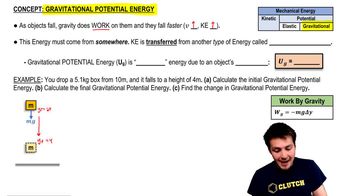
Gravitational Potential Energy

Gravitational potential energy (PE) is the energy an object possesses due to its position in a gravitational field. It is calculated using the formula PE = mgh, where m is the mass of the object, g is the acceleration due to gravity (approximately 9.81 m/s² on Earth), and h is the height above a reference point. In this case, the height is the maximum height the pebble reaches, which is 22.0 m.
Recommended video:
Guided course
06:35
Gravitational Potential Energy

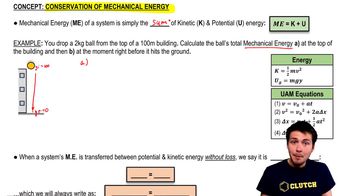
Conservation of Energy

The principle of conservation of energy states that energy cannot be created or destroyed, only transformed from one form to another. In the context of the slingshot, the elastic potential energy stored in the rubber band is converted into gravitational potential energy as the pebble is launched upward. This principle helps in understanding how the energy stored in the slingshot translates into the energy of the pebble at its peak height.
Recommended video:
Guided course
06:24
Conservation Of Mechanical Energy

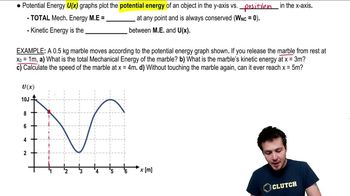
Elastic Potential Energy

Elastic potential energy is the energy stored in elastic materials as the result of their stretching or compressing. For a slingshot, this energy is stored in the rubber band when it is pulled back. The amount of elastic potential energy can be calculated using the formula PE_elastic = 1/2 kx², where k is the spring constant and x is the displacement from the equilibrium position. This energy is what propels the pebble when the slingshot is released.
Recommended video:
Guided course
07:24
Potential Energy Graphs
Related Practice
Textbook Question

A slingshot will shoot a 1010-g pebble 22.022.0 m straight up. With the same potential energy stored in the rubber band, how high can the slingshot shoot a 2525-g pebble? What physical effects did you ignore in solving this problem?

1
views

Textbook Question

A spring of negligible mass has force constant k=1600k = 1600 N/m. How far must the spring be compressed for 3.203.20 J of potential energy to be stored in it?

2
views
Textbook Question

A spring of negligible mass has force constant k=800k = 800 N/m. How far must the spring be compressed for 1.201.20 J of potential energy to be stored in it?

2
views
Textbook Question

In one day, a 7575-kg mountain climber ascends from the 15001500-m level on a vertical cliff to the top at 24002400 m. The next day, she descends from the top to the base of the cliff, which is at an elevation of 13501350 m. What is her change in gravitational potential energy on the first day?

14
views
Textbook Question

Tarzan, in one tree, sights Jane in another tree. He grabs the end of a vine with length 2020 m that makes an angle of 45°45° with the vertical, steps off his tree limb, and swings down and then up to Jane's open arms. When he arrives, his vine makes an angle of 30°30° with the vertical. Determine whether he gives her a tender embrace or knocks her off her limb by calculating Tarzan's speed just before he reaches Jane. Ignore air resistance and the mass of the vine.

1
views
Textbook Question

The maximum height a typical human can jump from a crouched start is about 6060 cm. By how much does the gravitational potential energy increase for a 7272-kg person in such a jump? Where does this energy come from?

1
views