Ch 23: Electric Potential
Young & Freedman Calc - University Physics 14th Edition
Young & Freedman Calc14th EditionUniversity PhysicsISBN: 9780321973610Not the one you use?Change textbook
Chapter 23, Problem 14a

A particle with charge +4.20+4.20 nC is in a uniform electric field EE directed to the left. The charge is released from rest and moves to the left; after it has moved 6.006.00 cm, its kinetic energy is +2.20x10⁶+2.20x10^{-6} J. What is the work done by the electric force?

Verified step by step guidance
1
Understand that the work done by the electric force on the particle is equal to the change in kinetic energy of the particle. This is based on the work-energy principle, which states that the work done on an object is equal to its change in kinetic energy.
Identify the initial kinetic energy of the particle. Since the particle is released from rest, its initial kinetic energy is 0 J.
Calculate the change in kinetic energy. The final kinetic energy is given as 2.20 × 10⁻⁶ J, and the initial kinetic energy is 0 J. Therefore, the change in kinetic energy is 2.20 × 10⁻⁶ J - 0 J = 2.20 × 10⁻⁶ J.
Recognize that the work done by the electric force is equal to the change in kinetic energy, which is 2.20 × 10⁻⁶ J. This is because the work-energy principle states that the work done by forces on an object is equal to the change in its kinetic energy.
Conclude that the work done by the electric force on the particle as it moves 6.00 cm to the left is 2.20 × 10⁻⁶ J.

Verified video answer for a similar problem:

This video solution was recommended by our tutors as helpful for the problem above.
Video duration:
1m
Was this helpful?

Key Concepts

Here are the essential concepts you must grasp in order to answer the question correctly.

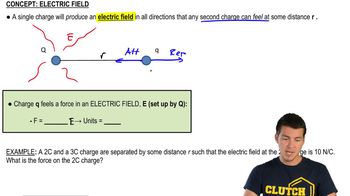
Electric Field

An electric field is a region around a charged particle where a force would be exerted on other charges. It is represented by the vector E and is measured in newtons per coulomb (N/C). The direction of the electric field is defined as the direction a positive test charge would move if placed in the field.
Recommended video:
Guided course
03:16
Intro to Electric Fields

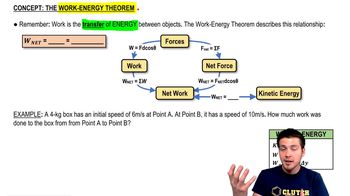
Work-Energy Principle

The work-energy principle states that the work done on an object is equal to the change in its kinetic energy. In this context, the work done by the electric force on the charged particle is equal to the increase in its kinetic energy as it moves through the electric field.
Recommended video:
Guided course
04:10
The Work-Energy Theorem

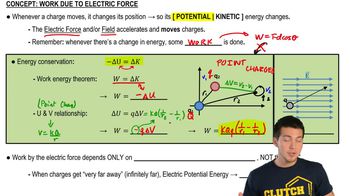
Electric Force

Electric force is the force exerted by an electric field on a charged particle. It is calculated using the formula F = qE, where q is the charge and E is the electric field strength. This force causes the particle to accelerate, changing its kinetic energy as it moves through the field.
Recommended video:
Guided course
14:21
Work due to Electric Force
Related Practice
Textbook Question

Two protons, starting several meters apart, are aimed directly at each other with speeds of 2.00×1052.00\(\times\)10^5 m/s, measured relative to the earth. Find the maximum electric force that these protons will exert on each other.
Textbook Question

Two stationary point charges +3.00+3.00 nC and +2.00+2.00 nC are separated by a distance of 50.050.0 cm. An electron is released from rest at a point midway between the two charges and moves along the line connecting the two charges. What is the speed of the electron when it is 10.010.0 cm from the +3.00+3.00-nC charge?

Textbook Question

Two protons are released from rest when they are 0.7500.750 nm apart. What is the maximum acceleration they will achieve and when does this acceleration occur?

1
views
Textbook Question

A small particle has charge 5.00-5.00 μμC and mass 2.00×1042.00\(\times\)10^{-4} kg. It moves from point AA, where the electric potential is VA=+200V_A = +200 V, to point BB, where the electric potential is VB=+800V_B = +800 V. The electric force is the only force acting on the particle. The particle has speed 5.005.00 m/s at point AA. What is its speed at point BB? Is it moving faster or slower at BB than at AA? Explain.

Textbook Question

Two point charges of equal magnitude QQ are held a distance dd apart. Consider only points on the line passing through both charges. If the two charges have the same sign, find the location of all points (if there are any) at which (i) the potential (relative to infinity) is zero (is the electric field zero at these points?), and (ii) the electric field is zero (is the potential zero at these points?).

2
views
Textbook Question

Point charges q1=+2.00q_1 = +2.00 μμC and q2=2.00q_2 = -2.00 μμC are placed at adjacent corners of a square for which the length of each side is 3.003.00 cm. Point aa is at the center of the square, and point bb is at the empty corner closest to q2q_2q2q_2. Take the electric potential to be zero at a distance far from both charges. (a) What is the electric potential at point a due to q1q_1 and q2q_2?

1
views