Ch 01: Concepts of Motion
Knight Calc - Physics for Scientists and Engineers 5th Edition
Knight Calc5th EditionPhysics for Scientists and EngineersISBN: 9780137344796Not the one you use?Change textbook
Chapter 1, Problem 28a

Perform the following calculations with the correct number of significant figures.
159.31 x 204.6

Verified step by step guidance
1
Identify the number of significant figures in each number. For 159.31, there are 5 significant figures, and for 204.6, there are 4 significant figures.
When multiplying or dividing numbers, the result should have the same number of significant figures as the number with the fewest significant figures. In this case, the result should have 4 significant figures because 204.6 has 4 significant figures.
Perform the multiplication: \( 159.31 \times 204.6 \). Do not round the result yet; keep all digits for now to avoid rounding errors.
Round the result to 4 significant figures, as determined in step 2. To do this, look at the fifth digit to decide whether to round up or down.
Express the final answer in proper scientific notation or standard form, ensuring it has exactly 4 significant figures.

Verified video answer for a similar problem:

This video solution was recommended by our tutors as helpful for the problem above.
Video duration:
1m
Was this helpful?

Key Concepts

Here are the essential concepts you must grasp in order to answer the question correctly.

Significant Figures

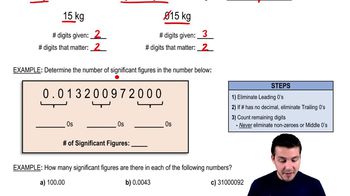
Significant figures are the digits in a number that contribute to its precision. This includes all non-zero digits, any zeros between significant digits, and trailing zeros in the decimal portion. Understanding significant figures is crucial for ensuring that calculations reflect the precision of the measured values.
Recommended video:
Guided course
04:44
Counting Significant Figures

Multiplication of Measured Values

When multiplying measured values, the result should be reported with the same number of significant figures as the measurement with the least number of significant figures. This rule ensures that the precision of the result is not overstated, reflecting the uncertainty inherent in the least precise measurement.
Recommended video:
Guided course
14:31
Equilibrium with Multiple Supports

Rounding Rules

Rounding rules dictate how to adjust numbers to maintain the correct number of significant figures. When the digit to be dropped is less than five, the last retained digit remains unchanged; if it is five or greater, the last retained digit is increased by one. Proper rounding is essential for maintaining the integrity of significant figures in calculations.
Recommended video:
Guided course
04:08
Kirchhoff's Junction Rule