Ch.6 - Alkyl Halides; Nucleophilic Substitution
Wade - Organic Chemistry 9th Edition
Wade9th EditionOrganic ChemistryISBN: 9780135213728Not the one you use?Change textbook
Chapter 6, Problem 2a,b

Give the structures of the following compounds.
a. methylene iodide
b. carbon tetrabromide

Verified step by step guidance
1
Step 1: Understand the naming conventions in organic chemistry. The names provided follow the IUPAC nomenclature system, which gives clues about the structure of the compounds based on prefixes, root names, and suffixes.
Step 2: For 'methylene iodide': The prefix 'methylene' refers to a single carbon atom bonded to two hydrogens (CH₂ group). The suffix 'iodide' indicates that two iodine (I) atoms are attached to this carbon. The structure can be represented as CH₂I₂.
Step 3: For 'carbon tetrabromide': The root 'carbon' indicates a single carbon atom. The prefix 'tetra-' means four, and 'bromide' specifies that four bromine (Br) atoms are attached to the carbon. The structure can be represented as CBr₄.
Step 4: Verify the valency of carbon in both structures. Carbon forms four bonds in total, which is satisfied in both CH₂I₂ (two hydrogens and two iodines) and CBr₄ (four bromines).
Step 5: Draw the structures for clarity. For CH₂I₂, the carbon is at the center with two hydrogens and two iodines attached. For CBr₄, the carbon is at the center with four bromines symmetrically attached.

Verified video answer for a similar problem:

This video solution was recommended by our tutors as helpful for the problem above.
Video duration:
2m
Was this helpful?

Key Concepts

Here are the essential concepts you must grasp in order to answer the question correctly.

Molecular Structure

Molecular structure refers to the three-dimensional arrangement of atoms within a molecule. It includes the types of atoms, the bonds between them, and their spatial orientation. Understanding molecular structure is crucial for predicting the physical and chemical properties of compounds, such as reactivity and polarity.
Recommended video:
Guided course
08:41
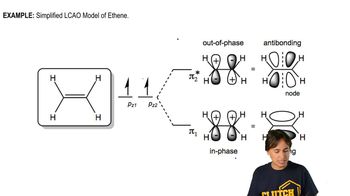
Review of Molecular Orbitals

Halogenated Compounds

Halogenated compounds are organic molecules that contain one or more halogen atoms (fluorine, chlorine, bromine, iodine) bonded to carbon. These compounds often exhibit unique reactivity patterns due to the electronegativity of halogens, which can influence the stability and reactivity of the molecule. Recognizing the halogen's role is essential for understanding the properties of methylene iodide and carbon tetrabromide.
Recommended video:
Guided course
03:45
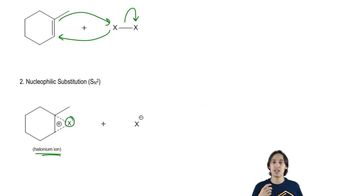
Halogenation Mechanism

Bonding and Hybridization

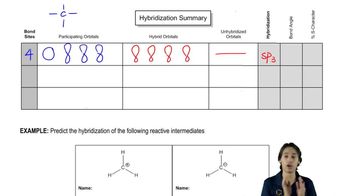
Bonding and hybridization describe how atomic orbitals combine to form bonds in molecules. In organic chemistry, understanding sp3, sp2, and sp hybridization is vital for predicting molecular geometry and bond angles. For example, methylene iodide (CH2I2) features sp3 hybridization, while carbon tetrabromide (CBr4) also exhibits sp3 hybridization, leading to tetrahedral geometries.
Recommended video:
Guided course
10:43
Using bond sites to predict hybridization