Ch.6 - Alkyl Halides; Nucleophilic Substitution
Wade - Organic Chemistry 9th Edition
Wade9th EditionOrganic ChemistryISBN: 9780135213728Not the one you use?Change textbook
Chapter 6, Problem 1d,e,f

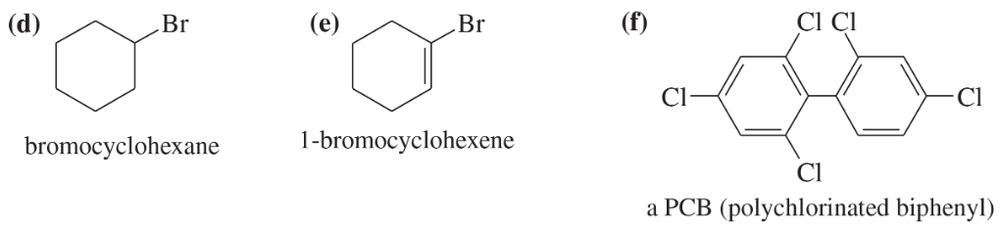
Classify each compound as an alkyl halide, a vinyl halide, or an aryl halide.

Verified step by step guidance
1
Step 1: Understand the definitions of the three classifications: An alkyl halide is a compound where a halogen atom (e.g., Br, Cl, I, F) is bonded to an sp³-hybridized carbon atom. A vinyl halide is a compound where a halogen atom is bonded to an sp²-hybridized carbon atom in a double bond. An aryl halide is a compound where a halogen atom is bonded directly to an aromatic ring.
Step 2: Analyze bromocyclohexane. In this compound, the bromine atom is attached to a carbon atom in a cyclohexane ring. Since the carbon is sp³-hybridized, bromocyclohexane is classified as an alkyl halide.
Step 3: Analyze 1-bromocyclohexene. In this compound, the bromine atom is attached to a carbon atom that is part of a double bond in a cyclohexene ring. Since the carbon is sp²-hybridized, 1-bromocyclohexene is classified as a vinyl halide.
Step 4: Analyze a PCB (polychlorinated biphenyl). PCBs consist of two benzene rings connected by a single bond, with multiple chlorine atoms attached to the rings. Since the chlorine atoms are bonded directly to aromatic rings, PCBs are classified as aryl halides.
Step 5: Summarize the classifications: Bromocyclohexane is an alkyl halide, 1-bromocyclohexene is a vinyl halide, and a PCB is an aryl halide. This classification is based on the hybridization of the carbon atom to which the halogen is attached and the structural context of the compound.

Verified video answer for a similar problem:

This video solution was recommended by our tutors as helpful for the problem above.
Video duration:
7m
Was this helpful?

Key Concepts

Here are the essential concepts you must grasp in order to answer the question correctly.

Alkyl Halides

Alkyl halides are organic compounds where a halogen atom (such as chlorine, bromine, or iodine) is bonded to an alkyl group, which is a saturated hydrocarbon chain. They are characterized by the general formula R-X, where R represents the alkyl group and X is the halogen. Common examples include bromoethane and chloropropane.
Recommended video:
Guided course
01:52
How to name alkyl halides

Vinyl Halides

Vinyl halides are a specific type of halogenated compound where the halogen is attached to a carbon-carbon double bond (alkene). They have the general structure R-CH=CH-X, where R is a hydrogen or alkyl group, and X is the halogen. An example is 1-bromopropene, which features a vinyl group.
Recommended video:
Guided course
01:52
How to name alkyl halides

Aryl Halides

Aryl halides are compounds in which a halogen atom is bonded to an aromatic ring, such as benzene. The general structure can be represented as Ar-X, where Ar is the aryl group and X is the halogen. Examples include bromobenzene and chlorotoluene, which exhibit unique reactivity due to the stability of the aromatic system.
Recommended video:
Guided course
01:52
How to name alkyl halides