Ch.9 - Alkynes
Wade - Organic Chemistry 9th Edition
Wade9th EditionOrganic ChemistryISBN: 9780135213728Not the one you use?Change textbook
Chapter 9, Problem 35a,b

Show how you would synthesize the following compounds from acetylene and any other needed reagents:
(a) 6-phenylhex-1-en-4-yne
(b) cis-1-phenylpent-2-ene

Verified step by step guidance
1
Step 1: Begin with acetylene (C₂H₂) as the starting material. To elongate the carbon chain, perform an alkylation reaction. First, deprotonate acetylene using a strong base like sodium amide (NaNH₂) to generate the acetylide ion. Then, react the acetylide ion with an appropriate alkyl halide (e.g., 1-bromobutane for part (a) and 1-bromopropane for part (b)) to add the desired carbon chain.
Step 2: For part (a), introduce the phenyl group. Use a second alkylation step by deprotonating the terminal alkyne again with NaNH₂ and reacting it with benzyl bromide (C₆H₅CH₂Br). This will attach the phenyl group to the chain. For part (b), the phenyl group can be introduced similarly, but ensure the chain length matches the target compound.
Step 3: To create the double bond in part (b), perform a partial hydrogenation of the alkyne using a Lindlar catalyst (Pd/CaCO₃, poisoned with quinoline). This will selectively reduce the alkyne to a cis-alkene. For part (a), retain the triple bond in the structure as required.
Step 4: For part (a), adjust the position of the triple bond and double bond as needed. Use hydroboration-oxidation (BH₃ followed by H₂O₂/NaOH) to convert the terminal alkyne into an alkene. Ensure the double bond is positioned correctly in the hex-1-en-4-yne structure.
Step 5: Verify the stereochemistry and connectivity of the final products. For part (b), ensure the cis configuration of the alkene is preserved. For part (a), confirm the phenyl group and the triple bond are correctly positioned in the 6-phenylhex-1-en-4-yne structure.

Verified video answer for a similar problem:

This video solution was recommended by our tutors as helpful for the problem above.
Video duration:
4m
Was this helpful?

Key Concepts

Here are the essential concepts you must grasp in order to answer the question correctly.

Alkyne Synthesis

Alkynes are hydrocarbons containing at least one carbon-carbon triple bond. They can be synthesized from simpler compounds like acetylene through various reactions, including elimination and coupling reactions. Understanding the mechanisms of these reactions is crucial for constructing more complex alkynes from simpler starting materials.
Recommended video:
Guided course
09:11
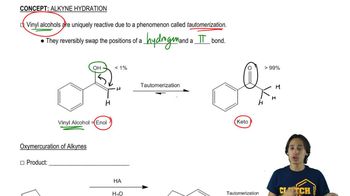
Alkyne Hydration

Electrophilic Addition Reactions

Electrophilic addition reactions involve the addition of electrophiles to nucleophilic sites in alkenes and alkynes. This concept is essential for synthesizing compounds like cis-1-phenylpent-2-ene, where the orientation of the addition can lead to different stereoisomers. Recognizing how to control regioselectivity and stereochemistry is vital in organic synthesis.
Recommended video:
Guided course
05:39
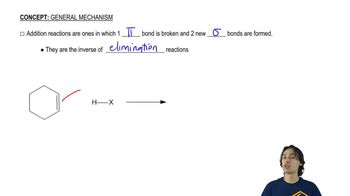
Features of Addition Mechanisms.

Reagents and Reaction Conditions

The choice of reagents and reaction conditions significantly influences the outcome of organic reactions. For synthesizing the specified compounds, reagents such as bromine, lithium diisopropylamide (LDA), or Grignard reagents may be required. Understanding how these reagents interact with acetylene and other substrates is key to achieving the desired products.
Recommended video: