Ch.9 - Alkynes
Wade - Organic Chemistry 9th Edition
Wade9th EditionOrganic ChemistryISBN: 9780135213728Not the one you use?Change textbook
Chapter 9, Problem 36a,b,c

Predict the products formed when CH3CH2–C≡C:Na+ reacts with the following compounds.
a. ethyl bromide
b. tert-butyl bromide
c. formaldehyde

Verified step by step guidance
1
Step 1: Analyze the structure of the given reactant in the image. Determine its functional groups, nucleophilicity, and electrophilicity. This will help predict how it interacts with the given compounds.
Step 2: For (a) ethyl bromide, identify the type of reaction that can occur. Ethyl bromide is a primary alkyl halide, which typically undergoes nucleophilic substitution (SN2 mechanism) with a strong nucleophile. Consider the reactant's nucleophilic site and predict the substitution product.
Step 3: For (b) tert-butyl bromide, recognize that it is a tertiary alkyl halide. Tertiary alkyl halides favor nucleophilic substitution via the SN1 mechanism due to steric hindrance. Predict the formation of a carbocation intermediate and the subsequent product based on the reactant's nucleophilic site.
Step 4: For (c) formaldehyde, understand that formaldehyde is an electrophile due to the partial positive charge on the carbon atom. The reactant's nucleophilic site will attack the carbonyl carbon, leading to the formation of an addition product. Predict the structure of the product based on this interaction.
Step 5: Summarize the predicted products for each reaction, ensuring that stereochemistry, regiochemistry, and reaction mechanisms are considered where applicable. This will provide a comprehensive understanding of the outcomes for each compound.

Verified video answer for a similar problem:

This video solution was recommended by our tutors as helpful for the problem above.
Video duration:
3m
Was this helpful?

Key Concepts

Here are the essential concepts you must grasp in order to answer the question correctly.

Nucleophilic Substitution

Nucleophilic substitution is a fundamental reaction in organic chemistry where a nucleophile replaces a leaving group in a molecule. This process can occur via two main mechanisms: SN1, which involves a two-step process with carbocation formation, and SN2, which is a one-step process where the nucleophile attacks the substrate simultaneously as the leaving group departs. Understanding these mechanisms is crucial for predicting the products of reactions involving alkyl halides like ethyl and tert-butyl bromide.
Recommended video:
Guided course
01:47
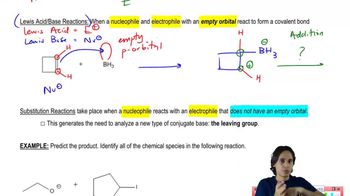
Nucleophiles and Electrophiles can react in Substitution Reactions.

Reactivity of Alkyl Halides

Alkyl halides, such as ethyl bromide and tert-butyl bromide, vary in their reactivity based on their structure. Primary alkyl halides (like ethyl bromide) typically undergo SN2 reactions due to steric accessibility, while tertiary alkyl halides (like tert-butyl bromide) favor SN1 reactions due to the stability of the resulting carbocation. Recognizing these differences is essential for predicting the outcome of reactions with these compounds.
Recommended video:
Guided course
01:52
How to name alkyl halides

Carbonyl Chemistry

Formaldehyde is a simple carbonyl compound that can undergo nucleophilic addition reactions. In these reactions, nucleophiles attack the electrophilic carbon of the carbonyl group, leading to the formation of alcohols or other derivatives. Understanding the behavior of carbonyl compounds is vital for predicting the products when they react with nucleophiles, such as those generated from alkyl halides.
Recommended video:
Guided course
04:20
Carboxylic Acids Nomenclature