Ch.9 - Alkynes
Wade - Organic Chemistry 9th Edition
Wade9th EditionOrganic ChemistryISBN: 9780135213728Not the one you use?Change textbook
Chapter 9, Problem 9

Show how you would synthesize 2-phenylhex-3-yn-2-ol, starting with acetophenone (PhCOCH3) and any other reagents you need. ("2-ol" means there is an OH group on C2.)

Verified step by step guidance
1
Step 1: Begin with acetophenone (PhCOCH3). Perform an alkylation reaction to introduce a hexynyl group at the alpha position. Use a strong base like NaNH2 to deprotonate the alpha hydrogen of acetophenone, forming an enolate ion. Then, react this enolate with 1-bromo-3-hexyne to attach the hexynyl group.
Step 2: After the alkylation, you will have 2-phenylhex-3-yn-2-one. To convert the ketone group into an alcohol group, perform a reduction reaction. Use a reducing agent such as NaBH4 (sodium borohydride) or LiAlH4 (lithium aluminum hydride) to selectively reduce the ketone to a secondary alcohol.
Step 3: Ensure stereoselectivity during the reduction step if necessary, as the product is 2-phenylhex-3-yn-2-ol. The reducing agent will add a hydrogen atom to the carbonyl carbon, forming the alcohol group.
Step 4: Purify the product using techniques such as recrystallization or column chromatography to isolate 2-phenylhex-3-yn-2-ol from any side products or unreacted reagents.
Step 5: Confirm the structure of the synthesized compound using spectroscopic methods such as NMR (nuclear magnetic resonance) and IR (infrared spectroscopy) to verify the presence of the alcohol group (-OH) and the alkyne (-C≡C-) functionality.

Verified video answer for a similar problem:

This video solution was recommended by our tutors as helpful for the problem above.
Video duration:
8m
Was this helpful?

Key Concepts

Here are the essential concepts you must grasp in order to answer the question correctly.

Alkyne Synthesis

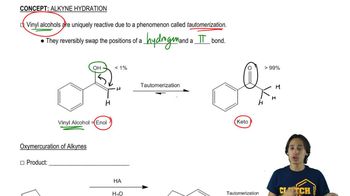
Alkyne synthesis involves the formation of carbon-carbon triple bonds, which can be achieved through various methods such as elimination reactions or coupling reactions. In this case, the synthesis of 2-phenylhex-3-yn-2-ol requires the introduction of a triple bond at the correct position in the carbon chain, which can be accomplished using reagents like sodium amide or alkyl halides.
Recommended video:
Guided course
09:11
Alkyne Hydration

Nucleophilic Addition to Carbonyls

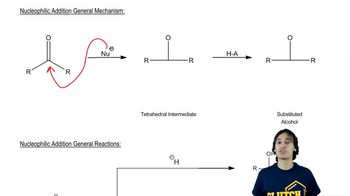
Nucleophilic addition to carbonyl compounds, such as acetophenone, is a fundamental reaction in organic chemistry. In this process, a nucleophile attacks the electrophilic carbon of the carbonyl group, leading to the formation of an alcohol. This step is crucial for synthesizing the desired alcohol functional group in 2-phenylhex-3-yn-2-ol.
Recommended video:
Guided course
08:27
Nucleophilic Addition

Functional Group Interconversion

Functional group interconversion refers to the transformation of one functional group into another, which is essential in organic synthesis. In this synthesis, converting the ketone group of acetophenone into an alcohol group is necessary. This can be achieved through reduction reactions, such as using lithium aluminum hydride (LiAlH4), to facilitate the conversion while maintaining the overall structure of the molecule.
Recommended video:
Guided course
02:36
Identifying Functional Groups