
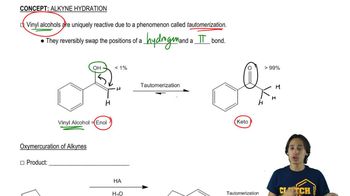
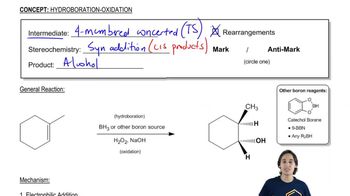
The hydroboration–oxidation of internal alkynes produces ketones.
b. When hydroboration–oxidation is applied to pent-2-yne, two products are obtained. Show why a mixture of products should be expected with any unsymmetrical internal alkyne.
Verified step by step guidance
The hydroboration–oxidation of internal alkynes produces ketones.
b. When hydroboration–oxidation is applied to pent-2-yne, two products are obtained. Show why a mixture of products should be expected with any unsymmetrical internal alkyne.
For each compound, give the product(s) expected from (1) HgSO4/H2SO4 - catalyzed hydration and (2) hydroboration–oxidation.
d. cyclodecyne
Disiamylborane adds only once to alkynes by virtue of its two bulky secondary isoamyl groups. Disiamylborane is prepared by the reaction of BH3·THF with an alkene.
a. Draw the structural formulas of the reagents and the products in the preparation of disiamylborane.
b. Explain why the reaction in part (a) goes only as far as the dialkylborane. Why is Sia3B not formed?
For each compound, give the product(s) expected from (1) HgSO4/H2SO4 - catalyzed hydration and (2) hydroboration–oxidation.
c. hex-3-yne
The hydroboration–oxidation of internal alkynes produces ketones.
a. When hydroboration–oxidation is applied to but-2-yne, a single pure product is obtained. Determine the structure of this product, and show the intermediates in its formation.
For each compound, give the product(s) expected from (1) HgSO4/H2SO4 - catalyzed hydration and (2) hydroboration–oxidation.
a. hex-1-yne