
Ch.9 - Alkynes
Wade - Organic Chemistry 9th Edition
Wade9th EditionOrganic ChemistryISBN: 9780135213728Not the one you use?Change textbook
Chapter 9, Problem 21a

For each compound, give the product(s) expected from (1) HgSO4/H2SO4 - catalyzed hydration and (2) hydroboration–oxidation.
a. hex-1-yne

Verified step by step guidance
1
Step 1: Analyze the structure of hex-1-yne. It is a terminal alkyne with the triple bond located between the first and second carbons in a six-carbon chain.
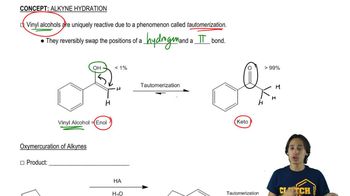
Step 2: For HgSO4/H2SO4-catalyzed hydration (acid-catalyzed hydration), the reaction proceeds via Markovnikov addition. The triple bond is converted into a ketone. The enol intermediate formed initially tautomerizes into a ketone, resulting in the product 2-hexanone.
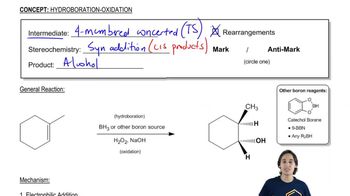
Step 3: For hydroboration-oxidation, the reaction proceeds via anti-Markovnikov addition. The triple bond is converted into an aldehyde. The enol intermediate formed initially tautomerizes into an aldehyde, resulting in the product hexanal.
Step 4: Understand the mechanism for each reaction. In acid-catalyzed hydration, the electrophilic addition of H⁺ occurs first, followed by nucleophilic attack by water and tautomerization. In hydroboration-oxidation, BH₃ adds to the less substituted carbon of the triple bond, followed by oxidation with H₂O₂/NaOH.
Step 5: Summarize the expected products: (1) HgSO4/H2SO4-catalyzed hydration yields 2-hexanone, and (2) hydroboration-oxidation yields hexanal.

Verified video answer for a similar problem:

This video solution was recommended by our tutors as helpful for the problem above.
Video duration:
6m
Was this helpful?

Key Concepts

Here are the essential concepts you must grasp in order to answer the question correctly.

Catalytic Hydration of Alkynes

Catalytic hydration of alkynes involves the addition of water across the triple bond in the presence of a catalyst, typically mercuric sulfate (HgSO4) and sulfuric acid (H2SO4). This reaction leads to the formation of a ketone or an aldehyde, depending on the position of the triple bond. For hex-1-yne, this process results in the formation of hexan-2-one.
Recommended video:
Guided course
09:11
Alkyne Hydration

Hydroboration-Oxidation

Hydroboration-oxidation is a two-step reaction that converts alkynes into alcohols. In the first step, the alkyne reacts with diborane (B2H6) to form a trialkylborane intermediate, which adds across the triple bond in a syn addition. The second step involves oxidation with hydrogen peroxide (H2O2) and sodium hydroxide (NaOH), yielding an alcohol. For hex-1-yne, this results in the formation of hexan-1-ol.
Recommended video:
Guided course
06:38
General properties of hydroboration-oxidation.

Markovnikov's Rule

Markovnikov's Rule states that in the addition of HX to an alkene or alkyne, the hydrogen atom will attach to the carbon with the greater number of hydrogen atoms already attached. This principle is crucial in predicting the products of reactions like catalytic hydration and hydroboration-oxidation. In the case of hex-1-yne, this rule helps determine the position of the functional group in the final products.
Recommended video:
Guided course
03:54
The 18 and 16 Electron Rule